Showing posts with label They Shall Have Stars. Show all posts

Tuesday, 14 May 2013

Films

The Spindizzy
In James Blish's Cities In Flight, Volume I, They Shall Have Stars, an anti-gravity device, the Dillon-Waggoner graviton polarity generator, nicknamed the "spindizzy," is invented;

in Volume II, A Life For The Stars, spindizzies are used to fly cities between stars faster than light;

in Volume III, Earthman, Come Home, they also fly a planet between galaxies and two cities to the Greater Magellanic Cloud;

in Volume IV, The Triumph Of Time, they fly a planet not only between galaxies but also to the Metagalactic Centre.

The Haertel Overdrive
In Blish's Welcome To Mars, Adolph Haertel discovers anti-gravity and flies a tree hut to Mars;

in "Common Time" and later works, the Haertel overdrive flies spacecraft between stars faster than light.

Thus, the spindizzy and the Haertel overdrive are alternative interstellar drives.

Film Ideas
Proposed films based on Blish's works were:

Welcome To Mars;
A Life For The Stars;
The Space Witch, an original flying cities film for which Blish wrote a plot outline.

One way to tie these films together would have been to rename the spindizzy as the "Haertel graviton polarity generator."

Thursday, 18 April 2013

Home Is Where Earth Is


"...my Earthmen will come home again...but I hope they won't stay." (James Blish, Cities In Flight, London, 1981), p. 129.

Wagoner wrote that because Blish wrote They Shall Have Stars as a prequel to Earthman, Come Home. Strictly speaking, it is not Wagoner's Earthmen, the first wave of Colonials, that return but the interstellar traders who are the heirs of a later Exodus from Earth. And they certainly do not stay. Some are killed by the Earth police whereas others migrate to the Greater Magellanic Cloud where John Amalfi says:

" '...now we're home...Home on Earth, for good...Earth is more than just one little planet, buried in another galaxy than this. Earth is much more important than that.
" 'Earth isn't a place. It's an idea.'" (pp. 464-465)

With that idea, we can be at home anywhere, even in the Greater Magellanic Cloud. The planet on which Amalfi speaks is in the following volume named "New Earth" and, appropriately, he had flown there in New York. In New York, New England, Nova Scotia, on New Earth and Terra Nova, people take their homes with them.

(In Larry Niven's Known Space future history, the Puppeteers' home planet turns out to be called "Hearth," a clever pun on "Earth" and "Heart.")

Complete Works Syndrome

With Poul Anderson and James Blish, I try to imagine an optimal reading order which is also potentially a way to repackage the volumes for any future Complete Works editions. Several of Blish's works fit together as two-volume sequences or "diptychs." Thus:

Welcome To Mars
the Galactic Cluster trilogy

The Star Dwellers
Mission To The Heart Stars

The Quincunx Of Time
Midsummer Century

Further, the Cities In Flight Tetralogy makes sense as a "double diptych":

They Shall Have Stars
A Life For The Stars

Earthman, Come Home
The Triumph Of Time

These four titles express or evoke a prelude, a life, a return and an ending, thus a complete Wagnerian Tetralogy. Neat.

Of the ten volumes listed here, five are adult novels, four are juvenile novels and one is a collection - in fact, a very short collection if we include only the "trilogy." Of the adult novels:

two are in fact amalgamations of shorter, previously published, works;
one is an expansion, still very short, of such a work;
and another, Midsummer Century, is itself very short, less than a hundred pages of text;
thus, perhaps only The Triumph Of Time is a full-length adult novel written as a unit.

Adolph Haertel, Jack Loftus and John Amalfi are, respectively, the unifying characters of the first, second and fifth diptychs listed above. The third diptych is unified by the presence of Thor Wald in the first volume and a reference to him in the second. The fourth is unified by the presence of Dillon and Wagonner in the first volume and the existence of the Dillon-Wagonner graviton polarity generator in the second.

Black Easter and The Day After Judgement formed a further diptych with a common cast of characters but came instead to be classified and published as a single novel and as Volume II of a Trilogy. Volume III, A Case Of Conscience, comprises "A Case Of Conscience," set on Lithia in 2049, expanded as Book One, and a continuation or sequel, set on Earth and the Moon in 2050, as Book Two. Thus, of the After Such Knowledge Trilogy, only Volume I, Doctor Mirabilis, was originally conceived as a single novel.

Thus, this "diptych" analysis has enabled us to summarize or survey the contents of Blish's Haertel Scholium, Cities In Flight and After Such Knowledge.

My motto is "There is always more."

Monday, 15 April 2013

A Style In Treason

James Blish's speculative hard science fiction (sf) addresses the questions: how can human beings live indefinitely, control gravity, travel faster than light (FTL), colonize other planets and communicate instantaneously or telepathically? Also, in particular works: what is life and should society be stable or dynamic?

(Incidentally, They Shall Have Stars prefigures The Star Dwellers:

("...there was no logical reason to rule [life] out even on the Sun - some animated flame no one would recognize as life..." (Year 2018!, London, 1964, p. 138))

Despite its interstellar setting, "A Style In Treason" concentrates not on hard sf but on colourful images and descriptions and exotic settings. It was written as a pastiche of Jack Vance who wrote the kind of sf in which technological advances like FTL are merely assumed, not carefully rationalized. The FTL drive in "A Style In Treason" is called the Imaginary Drive as an auctorial comment on the implausibility of this standard sf prop.

A battle is described as:

"...like a raid by the twenty-fifth century upon the thirteenth, as imagined by someone in the twentieth - a truly dreamlike sensation." (Anywhen, New York, 1970, p. 43)

- thus not intended to be taken seriously as either sociological or technological extrapolation. The battle includes ornithopters, wing-flapping aircraft, which are also to be found in Dune.

Sometimes, when reading a fictional narrative, we do not yet fully understand the context or motivations of the characters' actions but expect to understand more fully later. If this expectation is not fulfilled, then either we feel cheated or we accept that the narrative had other merits in any case. I am not sure that it is necessary to understand the convoluted intrigues of the self-described "Traitors." I remarked to Blish that I did not understand how a system based on treason could work and he replied that he did not understand it either. A further novel would have been written.

Textually, there is a contradiction between internal and external evidence. Internally, the text states:

"Neither the [faster than light] ultraphone nor the Imaginary Drive permitted the extension of human hegemony over a radius of more than ten light-years..." (ibid., p. 27)

- but explains that "...a roughly uniform interstellar economy...," in which the traitors "...act as brokers..." enforces a rule that is not widely recognized as such.

Externally, the characters in The Quincunx Of Time receive on their instantaneous Dirac transmitter a message describing the civilizations of "A Style In Treason" and addressing an audience within one of those civilizations. The Dirac transmitter is used to extend human hegemony across galaxies. Indeed, the Milky Way and the Magellanic Clouds had been federated two and a half millennia before the Traitors' Guild period.

However, the use of the Dirac is deliberately limited and the Traitors' Guild system is based on deception so no doubt it would have been possible to devise some way to fit these ostensibly incompatible narratives into a single timeline.

Saturday, 23 March 2013

What The Okies Do IX

The first textual confirmation that James Blish's A Life For The Stars follows his They Shall Have Stars is a casual reference to "spindizzies" on p. 135 (Cities In Flight, London, 1981). The earlier references to flying cities should not have meant anything to us yet unless we have looked ahead to Earthman, Come Home.

The background detail that technology has caused mass unemployment does not feature elsewhere in this series but does connect with two other Blish juveniles, the Jack Loftus novels, and with A Torrent Of Faces which Blish co-wrote with Norman L Knight.

A Life For The Stars reads like a Heinlein juvenile and is particularly reminiscent of Starman Jones. Although Poul Anderson's The Game Of Empire is not a juvenile, it has a similar opening passage when its teenage viewpoint character sees a quadrupedal alien approaching. The opening chapter of A Life For The Stars also has some, very different, parallels with CS Lewis' Out Of The Silent Planet. In both the hero, is kidnapped and physically coerced to leave Earth although Lewis' character is taken to Mars whereas Blish's text has already told us about Pittsburgh on Mars.

Lewis quotes Milton:

"...day never shuts his eye,
"Up in the broad fields of the sky..."

- whereas Blish's character thinks of "...Eternal Daylight Saving Time." (p. 144)

We are told that the flying cities "...provided badly needed industrial strength..." to the extra-solar colonies (p. 170). This makes sense. Small groups of Colonials had flown to Earth-like planets but how much industrial technology could they have transported with them?

We are given more details about how New York is to help industrialize the planet called Heaven. The Archangels want undersea farming and herding, as on Venus, with broadcast power. The Okies are to:

excavate in the wet terrain;
build the generator-transmitter station;
refine thorium and other power metals which Heaven has but cannot process in quantity;
receive payment in the precious metal germanium since, isolated as yet from interstellar trade, the Archangels have few Oc dollars.

Afterwards, the Archangels aim to have their own refineries and to sell to other planets. As they are Russian-speaking feudal lords, they cannot have been part of the original wave of Western colonists but must have left Earth later when the exodus of the cities began.

Wednesday, 20 March 2013

What The Okies Do II

The richness of James Blish's Cities In Flight is shown by the fact that not only can each of the four volumes be discussed in detail and at length but also each raises a different issue or issues:

in Volume I, McCarthyism, biology, the Jovian environment, physics and psychology;
in II, technological unemployment and education;
in III, adventure fiction and economics;
in IV, cosmology.

In Vol III, Earthman, Come Home, the Okie city of New York is legally obliged to get permission from the authorities on the colonised planet of He before mining their planet for germanium. In return, the Okies will wipe out the Hevian jungle and share the anti-agathics. Thus, if He had not been colonised or if the Okies had been willing to act illegally, then they could have mined the planet without having to give anything in return. So far, in Earthman, we have seen New York mining Utopia, offering to mine Gort and again mining He. So we come back to the questions: Why do the cities need paid work? Can they not be self-sufficient? I will try to defend the economic basis of the series.

Vol I, They Shall Have Stars, concentrates on the two discoveries, one in biology, the other in physics, that make interstellar travel possible but otherwise makes an assumption that is common to much science fiction (sf):

" 'Richardson Observatory, on the Moon, has two likely-looking systems mapped already - one at Wolf 359, the other at 61 Cygni - and there are sure to be others, hundreds of others, where Earth-like planets are highly probable.' " Cities In Flight (London, 1981), p. 123.

Highly probable that there are many planets where human beings can breathe the air and drink the water as if they had merely flown to another continent on Earth? In Blish's parallel series, The Seedling Stars, human beings must be "Adapted," by the science of pantropy, before they can colonize (many) other planets. An "ultimate" Blish novel might have been one incorporating all his divergent and convergent concepts into a single narrative:

the spindizzy and/or the Haertel overdrive;
the anti-agathics;
the Dirac transmitter, with the "beep";
pantropy;
the Arpe drive exploring the microcosm;
a single all-encompassing rationale for telepathy;
etc.

We suppose that the "Colonials" who left the Jovian system in 2021 were well equipped to survive on and to start terraforming a few extra-solar planets. Three and a half centuries later, Thorium Trust Plant no 8 uses the rediscovered spindizzy to leave the Solar System and to seek work among the colonists who have by now made a few planets fully habitable. The Plant is equipped to mine and refine thorium but not to colonize so the colonists somehow pay it to help them industrialize. The Exodus from Earth begins and germanium becomes the standard of exchange. The colonists have already settled those planets that can most accurately be described as "Earth-like." There is not a large number of uninhabited planets with mine-able oil deposits and they are not easy to find. The Okies become part of an economy in which they assist in planetary development in exchange for Oc dollars or the right to mine for what they need. The Colonials of 2021 had had both the spindizzy and the anti-agathics but somehow the latter come to be used mostly by those who need them most, the Okies.

I will continue to reread the series noting what is said about contracts between cities and planets. Amalfi from New York compares notes with an Okie from another city. New Yorkers are mainly miners and petroleum geologists but have developed sidelines. The other city were agronomists working on the periphery, "'...teaching abandoned colonies...how to work poisoned soil and manage low-yield crops without heavy machinery...,'" with a sideline in soil-source antibiotics (p. 313). They " '...converted to a barter economy as soon as we got out of the last commerce lanes.' " (p. 313)

Barter must also have preceded the germanium standard.
Monday, 18 March 2013

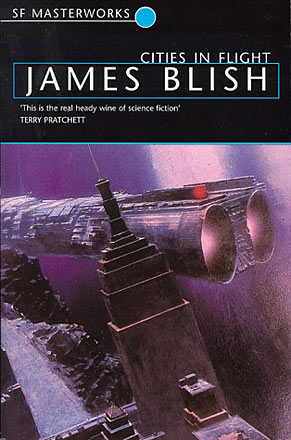
Cities In Flight, Volume I

James Blish wrote They Shall Have Stars (alternative title: Year 2018!) specifically as a prequel/prelude/prologue to the Okie series collected as Earthman, Come Home. These are two very different volumes. Earthman is a four episode adventure series with a single central character whereas Stars has three alternating viewpoint characters because it is a three-layered political, scientific and psychological novel.

A US Senator politically outmaneuvers his opponents including the director of the FBI. A Jovian explorer resolves his own psychological response to the hostile environment. The novel is science fiction because it is set in the future and assumes space travel and other scientific advances but it is also "scientific" in that it dramatises scientific enquiry and procedures. Hence, the three layers of politics, science and psychology. The scientific and psychological layers were originally published as separate stories. Thus, these two volumes incorporate six previously published works.

They Shall Have Stars is a good novel of beginnings, therefore also of endings preceding beginnings. What is beginning, as indicated by the title, is the faster than light travel with physical immortality of Earthman, Come Home. The concluding chapter ends when two Jovian explorers:

"...looked past the discarded bulk of Jupiter at the near horizon, where there had always been visible a few stars." (Cities In Flight, London, 1981, p. 128)

- and the brief Coda begins:

" 'Every end,' Wagoner wrote on the wall of his cell on the last day, 'is a new beginning. Perhaps in a thousand years my Earthmen will come home again.' " (p. 129)

The last day of the life of the man who gave mankind the stars is the end of the first volume.

Friday, 15 March 2013

Bliss Wagoner

In James Blish's They Shall Have Stars (IN Cities In Flight, London, 1981):

"PRELUDE: Washington," set in the winter of 2013, describes a conversation between Senator Bliss Wagoner and Dr Guiseppi Corsi;

in "INTERMEZZO: Washington," Wagoner reads the report of the investigating sub-committee of the Senate Finance Committee on the Jupiter Project, which includes the questioning of Dr Corsi;

"ENTR'ACTE: Washington" is a letter dated 4th January 2020 from Wagner to Corsi;

in "CHAPTER NINE: New York," Wagoner meets Paige Russell, the viewpoint character of the odd numbered "New York" chapters;

in CHAPTER TEN: Jupiter V," Wagoner and Russell meet Robert Helmuth, view point character of the evenly numbered "Jupiter V" chapters;

in "CODA: Brookhaven National Laboratories (the pile-dump)," Wagoner writes on the wall of his cell on the last day.

Thus, Wagoner is a unifying character like Guion in Poul Anderson's The Shield Of Time. His name suggests Blish and Wagner? Wagner is mentioned in the text (p. 104), Wagoner's sections have musical headings, Blish mentioned Wagner in an Introduction to one of the Cities In Flight volumes and there is an echo of Wagner in an earlier version of the Chronology of Cities In Flight when John Amalfi is said to have died not at the end of the universe but in a hunting accident.

Brian Aldiss wrote that Blish's The Quincunx Of Time really is about the future. Not only is it set in our future but also its characters receive messages from different periods of their future. Similarly, They Shall Have Stars really is about science. Wagoner's letter to Corsi outlines the scientific methods that are used to discover the anti-agathics and antigravity that are the science fictional premises of the novel.

Thursday, 14 March 2013

The Structure Of They Shall Have Stars

BOOK ONE
PRELUDE: Washington (set in 2013!)
CHAPTER ONE: New York
CHAPTER TWO: Jupiter V
CHAPTER THREE: New York
CHAPTER FOUR: Jupiter V

BOOK TWO
INTERMEZZO: Washington
CHAPTER FIVE: New York
CHAPTER SIX: Jupiter V
CHAPTER SEVEN: New York
CHAPTER EIGHT: Jupiter V

BOOK THREE
ENTR'ACTE: Washington
CHAPTER NINE: New York
CHAPTER TEN: Jupiter V
CHAPTER ELEVEN: Jupiter V
CODA: Brookhaven National Laboratories (the pile-dump)

The short story, "At Death's End," featuring Colonel Paige Russell of the Army Space Corps and dealing with biology, is incorporated as the New York chapters.

The short story, "Bridge," featuring Robert Helmuth, foreman of the Bridge gang, and dealing with Jupiter, is incorporated as the Jupiter V chapters.

New material featuring Senator Bliss Wagoner and dealing with politics is presented in the Washington and Brookhaven sections. The characters meet in Chapter Ten which is narrated from Helmuth's point of view since it is set on Jupiter V.

The novel is a prequel to the Okie series, collected as Earthman, Come Home. The interstellar traders called "Okies" use anti-agathics, developed in New York, and antigravity, based on equations confirmed on Jupiter.

Blish establishes a future history background in a few pages. The Prelude is a conversation between Wagoner and Dr Corsi of the AAAS. They mention MacHinery of the FBI. Russell, waiting for an interview in Chapter One, sees celebrities including Wagoner, Corsi and MacHinery pass by. He himself mentions being on " '...Jupiter V, right in the shadow of the Bridge gang's shack...' " (Cities In Flight, London, 1981, p. 20) before we first encounter the Bridge, a classic sf setting, in Chapter Two. It is a pity that the Bridge makes such a brief appearance in just six short chapters, or one short story, but it serves its purpose and cannot long survive in the Jovian environment.

Tuesday, 24 April 2012

James Blish: The End Of The World

James Blish presents five end of the world scenarios:

a cosmic collision;
a nova;
Armageddon;
an asteroid strike;
an ecological catastrophe.


(By a cosmic collision, I mean not a collision on a cosmic scale but literally a collision between two universes.)

Blish usually tells us what happened afterwards:

“Creation began.” 1
“We have escaped…we will survive.” 2
“…Resurrection.” 3
“…the world was ready to begin.”4

Only the ecological catastrophe story ends without hope because, like Orwell’s 1984 and Blish’s own They Shall Have Stars, it is a warning. The catastrophe tidally disrupts the Earth-Moon system so that lunar bases are no escape. Thus, the story ends not with a new beginning but with a dying moment:

“Juli felt the soft, familiar thump of Hausmaus [a cat] landing on his frequent perch between her shoulder blades, and ”5

Blish was not usually pessimistic. They Shall Have Stars, despite its political dystopia, has an up-lifting title and ends when exiles escape from the world Bureaucratic State which will be overthrown in a later volume. On the last page, a man about to be executed writes on the wall of his cell:

“Every end…is a new beginning.”6

- thus echoing the positive endings of four of the five end of the world scenarios.

  1. James Blish, The Triumph Of Time in Blish, Cities In Flight (London: Arrow Books, 1981), p. 596.
  2. James Blish, …And All The Stars A Stage (New York: Doubleday & Company, 1971), p. 84.
  3. James Blish, Black Easter and The Day After Judgement (London: Arrow Books, 1981), p. 208.
  4. James Blish and Norman L. Knight, A Torrent Of Faces (London: Arrow Books, 1978), p. 270.
  5. James Blish, “We All Die Naked” in Silverberg, Zelazny, Blish, Three For Tomorrow (New York: Meredith Press, 1969), p. 204.
  6. James Blish, They Shall Have Stars in Cities In Flight, p. 129.