Wednesday, 25 March 2026

Haertel's Significance In Three Timelines III

In The Star Dwellers:

It is 2050:

"...nearly two decades after the discovery of the Haertel faster-than-light drive..."
-James Blish, The Star Dwellers (London, 1979), 3, p. 34.

That year, 2050, makes the events of this juvenile novel contemporaneous with those of A Case Of Conscience, Book Two, although the two novels are set in different timelines. Four other intelligent species are known of in The Star Dwellers whereas, in A Case Of Conscience, the Lithians are the first such species.

The Haertel field protects passengers from the effects of acceleration in over-the-atmosphere rocket flights and in interplanetary flight.

Milne had transformed Lorenz-Fitzgerald contraction and mass increase from natural laws into a teaching convenience, thus eliminating the light-speed limit. Haertel had used Mach's axiom to show that this limit disappeared if the mass of the whole universe was taken into account. Engineers inserted different probable values for M into Haertel's equations until one worked.

Every time that we read about Haertel's discovery, it is a different account. I do not think that there is any comparable information in A Case Of Conscience but, in any case, incapacitated with a cold, I am not about to look for it. Probably a retreat to passive reading for the rest of today.

Scholium Criteria

The criterion for inclusion of a text in the New Testament was whether this text proclaimed the Resurrection of Christ in fulfilment of scripture, not whether the text was otherwise consistent with other texts in the canon. 

A comparable criterion applies to James Blish's Haertal Scholium. A story or novel may refer either to Haertel himself or to some other element of an earlier narrative while not necessarily maintaining full consistency with every other such additional instalment. Thus, "A Dusk of Idols" and Mission To The Heart Stars both refer back to The Star Dwellers but are not necessarily mutually consistent. Haertel and Garrard exist in the past of a story where a telepathic "Central Empire" occupies the galactic centre and also in the past of a novel where the non-telepathic Hegemony of Malis occupies that same volume of space.

Story elements even extend beyond the Scholium:

in "A Case of Conscience," which became Book One of the Scholium novel, A Case Of Conscience, the planet Lithia exists in 2049;

in Book Four of the non-Scholium collection, The Seedling Stars, Lithia still exists millennia later;

in Book Two of A Case Of Conscience, Lithia explodes in 2050.

The Dirac transmitter:

first appeared in Blish's Okie series;

was developed more fully in the independent story, "Beep";

was not only developed further yet again but also incorporated into the Haertel Scholium when "Beep" was expanded as The Quincunx Of Time and linked by a Dirac message to Midsummer Century.

Einstein and Mars exist in alternative fictional futures. So likewise may Haertel, Lithia and the Dirac transmitter.

Haertel's Significance In Three Timelines II

See: Haertel's Significance In Three Timelines

Publication Order
The Star Dwellers (1961)
Mission To The Heart Stars (1965)
Welcome To Mars (1966)
Midsummer Century (1972)
The Quincunx Of Time (1973)

Only the first, second and fifth of these Haertel Scholium novels present a scenario of interstellar civilization with regular use of the Haertel overdrive. Mission To The Heart Stars, a direct sequel to The Star Dwellers, culminates when "Angels" (energy beings) and Earthmen begin to lead an alliance of other intelligent species, including dolphins, beadmungen and the feline Aaa, against the Heart Stars federation, the Hegemony of Malis, whereas, in The Quincunx Of Time, Earth alone, monopolizing the instantaneous Dirac transmitter with its messages from the future, leads a utopian intergalactic civilization. If the Haertel Scholium had comprised a single linear sequence, then the Martian dune-cats in Welcome To Mars might have taken the place of the Aaa in the two Jack Loftus novels.

In Welcome To Mars:

Einstein maintained that gravity was not a force but a condition of space and tried to prove that it lacked polarity;

Milne's relativity incorporated Einstein's;

in the late twentieth century, Adolph ("Dolph") Haertel, aged seventeen, studied Milne, Dingle and any other theoreticians of gravity;

Haertel discovered that gravity has polarity and can be easily manipulated by working with it instead of against it.

In James Blish's Cities In Flight, control of gravity (with polarity) leads to a faster-than-light interstellar drive. Is this what happens in the Haertel Scholium, at least in that branch of the Scholium represented by Welcome To Mars? Alternatively, one Haertel discovers anti-gravity and another discovers FTL. Texts bear alternative interpretations.

In The Quincunx Of Time:

Haertel, aged seventeen, assumed that the geometry of ultimate particles is Pythagorean, not Euclidean, applying to points, not to lines, and thus transformed particle physics;

Haertel's assumption generated a Unified Field Theory and abolished both the equivalency principle and most of quantum mechanics except the part that is necessary for the Dirac transmitter;

Thor Wald, inventor of the transmitter, jocularly suggests that Haertel "'...must have been God...'" (James Blish, The Quincunx Of Time (New York, 1973), CHAPTER SIX, p. 67)

The Quincunx Of Time follows Welcome To Mars by stating that Haertel did something important at the age of seventeen. However, he either discovered anti-gravity or assumed Pythagorean particle geometry. These seem to be completely different. 

Tuesday, 24 March 2026

Haertel's Significance In Three Timelines


If the central character of James Blish's Welcome To Mars had not been surnamed Haertel, then there would have been no reason to classify this novel as belonging to the Haertel Scholium. 

Publication Order
The Star Dwellers (1961)
Mission To The Heart Stars (1965)
Welcome To Mars (1966)
Midsummer Century (1972)
The Quincunx Of Time (1973)

The first and second titles form a pair as do the fourth and fifth. Thus, these five novels present three narratives.

In Mission To The Heart Stars:

Einstein ruled out faster-than-light travel;

"Milne...taught that the speed-of-light limitation was only a mathematical limitation, not a natural law."
-James Blish, Mission To The Heart Stars (London, 1980), CHAPTER FOUR, p. 47;

in the mid-1960's, Dingle found errors in Einstein's reasoning;

in 2011, a paper by Haertel showed that Einstein's relativity was a special case of Milne's which was a special case of Haertel's;

in 2030, faster-than-light interstellar travel began.

Jack Loftus is the hero of these first two novels. Jack's mentor, Dr Langer, thinks that Haertel was the greatest theoretical physicist ever.

It remains to summarize information about "Haertel" as given both in Welcome To Mars and in The Quincunx Of Time. However, it is getting late here and there is always tomorrow.

Monday, 23 March 2026

Radio, Dirac And Cats

James Blish's Haertel Scholium begins with Welcome To Mars and ends with Midsummer Century.

See: One Story Grows Into An Exotic Future History.

In Welcome To Mars, Dolph Haertel, stranded on Mars in the twentieth century, unexpectedly receives a radio signal originating from somewhere else on that planet whereas, in Midsummer Century, John Martels, who has been time-projected from 1985 to 25,000 AD and who is now embodied in a sentient computer, unexpectedly receives a message transmitted as a Dirac beep. These two mysterious receptions suggest a bond between these two characters although they are not in any direct contact with each other. The Scholium is all about faster means of travel and communication. Haertel and Martels are indirectly linked by Thor Wald who reveres Haertel and invents the Dirac transmitter.

The Scholium includes two cat-like intelligent species, one on Mars in the two Mars instalments and another on an extra-solar planet in the two Jack Loftus novels. If the Scholium or selected parts of it had been edited into a linear series, then maybe these two species would have been conflated.

Sunday, 22 March 2026

Haertel Timelines

Although James Blish's Haertel Scholium does not comprise a single linear future history series, it could be republished in a boxed-set uniform edition with minimal editing. Such a set should exclude the novel, A Case Of Conscience, because that is Volume III of the After Such Knowledge Trilogy and need not be collected twice, which leaves six volumes:

Two Adolph Haertel Volumes
Welcome To Mars
Galactic Cluster: Revised Edition ("No Jokes on Mars" + the short Haertel trilogy)

These first two volumes cover:

Haertel on Mars
Mars
Haertel
Haertel's successors

Two Jack Loftus Novels
The Star Dwellers
Mission To The Heart Stars (+ "A Dusk of Idols")

Two Thor Wald Volumes
The Quincunx Of Time (+ "A Style in Treason")
Midsummer Century

The second and third pairs cover alternative successors of Haertel.

There are alternative versions of Mars and also of the galactic centre. The Haertel who is directly referenced in Mission To The Heart Stars and the Haertel who is indirectly referenced in "This Earth of Hours" cannot be the same Haertel because these works present mutually incompatible accounts of what is to be found at the galactic centre. Consequently, Haertel exists in different timelines.

Versions Of Mars

In James Blish's Cities In Flight, Volume I, They Shall Have Stars, and in the second of Blish's two Jack Loftus novels, Mission To The Heart Stars, the long extinct Martians had covered their planetary surface with the Diagram of Power.

In Blish's first Haertel Scholium novel, Welcome To Mars, Martian canals are crustal faults or spalled cracks caused by meteor impacts and the intelligent six-foot-long dune-cats had been domesticated by the just-extinct Old Martians whereas, in "No Jokes on Mars," the four-foot-long but otherwise identical dune cats (unhyphenated) are possibly descended from the long-extinct Canal Masons.

In After Such Knowledge, Volume III, A Case Of Conscience, there are unintelligent Martian sand crabs.

The "Diagram of Power" Mars exists in two timelines, those of Cities In Flight and of the Loftus novels.

Although Blish stated that "No Jokes on Mars" was set at least a decade later than Welcome To Mars, it is clear that the story and the novel are set on similar but different versions of Mars and therefore in different timelines.

Neither version of the dune-cats exists on the "Diagram of Power" Mars but the sand crabs might although there is no reason to think that they do.

Sunday, 2 November 2025

The Haertel Scholium

James Blish's Haertel Scholium comprises:

(i) four stories collected in Galactic Cluster, the first featuring Adolph Haertel;

(ii) five novels - one about Haertel, the others referring to him;

(iii) four more shorter works, three stories collected in Anywhen and the short novel, Midsummer Century.

(i) A linear trilogy:

"Common Time"
"Nor Iron Bars"
"This Earth of Hours"

- and an offshoot, "Beep," which is a further development of the idea of the instantaneous Dirac transmitter which had been introduced in Blish's Cities In Flight Tetralogy.

(ii) (a) Three juvenile novels:

Welcome To Mars, about Haertel;

The Star Dwellers and Mission To The Heart Stars, both about Jack Loftus.

(b) A Case Of Conscience, which is Volume III of the After Such Knowledge Trilogy.

(c) The Quincunx Of Time, a (still short) novelization of "Beep."

(iii) Each of the four remaining shorter works connects with one of the novels:

"No Jokes on Mars" with Welcome To Mars;

"A Dusk of Idols" with The Star Dwellers;

"A Style in Treason" and Midsummer Century with The Quincunx Of Time.

Midsummer Century, written while Blish was expanding "Beep," is a companion volume to The Quincunx... The two volumes cross-refer and are linked by a Dirac message.

Everything comes together.

Thursday, 20 February 2025

James Blish And Poul Anderson

I post more about Poul Anderson than about James Blish if only because Anderson had a much bigger output. Blish's main future history series, Cities In Flight, is four volumes or one omnibus volume with a beginning, a middle and an end whereas Anderson's History of Technic Civilization is seventeen volumes or seven omnibus volumes and remained open-ended. Blish's characters face the end of the universe in Cities In Flight, Volume IV, The Triumph Of Time, whereas a different set of Anderson's characters face the same problem in the non-series novel, Tau Zero. Blish's characters fly to the Metagalactic Centre in The Triumph Of Time whereas different sets of Anderson's characters fly between galaxies in the non-series novels, Tao Zero and World Without Stars. Blish's characters live indefinitely prolonged lifespans in Cities In Flight whereas different sets of Anderson's characters live indefinitely prolonged lifespans in the non-series novels, World Without Stars, The Boat Of A Million Years and For Love And Glory and in his Time Patrol series.

However, because of several parallels between these two authors, we frequently refer to Blish on the Poul Anderson Appreciation blog. Currently, see here. More generally, see here.

Tuesday, 6 August 2024

Narrative Growth


A single Okie story became the concluding fourth section of Earthman, Come Home which became Volume III of the Cities In Flight Tetralogy which, in turn, was collected in a single omnibus volume.

A single pantropy story became Cycle One of Book Three of The Seedling Stars, a single volume.

A single theological sf story became Book One of A Case Of Conscience which became Volume III of the After Such Knowledge Trilogy, eventually collected in a single omnibus volume.

A single Haertel overdrive story became the basis of the Haertel Scholium which includes A Case Of Conscience.

Tuesday, 2 April 2024

James Blish's Main Works

Blish's Four Main Bodies of Work
Cities In Flight
The Seedling Stars
The Haertel Scholium
After Such Knowledge

Haertel Scholium works either feature or refer, directly or indirectly, to Adolph Haertel.

After Such Knowldege, Volume III, A Case of Conscience, is a Haertel Scholium novel.

Blish's main bodies of work can also be listed as three future histories and three (Haertel-related) trilogies.

Future Histories
Cities In Flight
The Seedling Stars
The Haertel History

Trilogies
The Heart Stars Trilogy
The Quincunx Trilogy
After Such Knowledge

Thursday, 3 January 2019

4004 Or 4104

In successive versions of the Chronology of Cities in Flight:

John Amalfi died in a hunting accident in 4004;

the universe ended in 4004;

the universe ended in 4104.

That last event and date remained in the text but the Chronology was left out of the omnibus edition.

The hunting accident, appearing in the Chronology but not in any text, was just meant as a reminder that even people with antiagathics will eventually die by accident or violence. When Blish did come to write an ending, he had his characters living until the end of the universe which, however, was brought unexpectedly close to the present for narrative purposes.

Thursday, 25 October 2018

Two Boxed Sets?

Three Future Histories
Cities In Flight
The Seedling Stars
The Haertel History

Three Trilogies
Heart Stars
Quincunx
After Such Knowledge

You might have to read or reread previous posts to see what I am getting at here.

The future histories culminate respectively in:

Volume IV, The Triumph Of Time;
Book Four, "Watershed";
"This Earth of Hours."

Citiess In Flight, Volume III, is Earthman, Come Home, a title that could be applicable in different ways to both "Watershed" and "This Earth of Hours."

Tuesday, 2 October 2018

And After Such Knowledge

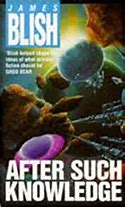
I should have said six volumes here. After Such Knowledge, which has been collected in a single volume (see image), begins with the discovery of scientific method by Roger Bacon in Doctor Mirabilis and climaxes with an unexpected outcome of the supernatural conflict of Armageddon in The Day After Judgment.

Schematically, Black Easter and its sequel, The Day After Judgment, considered as a single work, comprise Volume II of the After Such Knowledge Trilogy with A Case Of Conscience as Volume III. In this order, the three volumes correspond to past, present and future, respectively, and also form a Hegelian triad of historical fiction, fantasy and science fiction, sf synthesizing the realism of historical fiction with the counter-factuality of fantasy.

However, Volume II, written last, is surely a dramatic climax, realizing the apocalyptic apprehensions of Volumes I and III?

"This Earth Of Hours"

James Blish's "This Earth of Hours," ending with the beginning of an interstellar conflict between the telepathic, unitive civilizations of Population I stars and the brained, warring civilizations of Population II stars, should not be just another short story in a collection. Coming, as it does, after:

"Nor Iron Bars," which introduces telepathy;

before that, "Common Time," which introduces interstellar travel, initially with the Haertel overdrive;

before that, Welcome To Mars, about Haertel on Mars, and "No Jokes on Mars," about later events on Mars -

- "This Earth of Hours" is a culmination no less than Book Four of The Seedling Stars or Volume IV of Cities In Flight and should be published at the end of a volume containing the five relevant works in the appropriate order with the divergent branches of the Haertel Scholium in separate volumes.

Thus, five volumes (correction: six; see here) would each begin with an important discovery or discoveries, then progress towards a climax galactic, intergalactic or even cosmic in scope.

Monday, 1 October 2018

"How Beautiful With Banners"

Whereas James Blish's "Nor Iron Bars" is a direct, linear sequel to his "Common Time," his "How Beautiful With Banners" is a conceptual sequel to that same story because symbolism that had been unconscious, although later recognized as such, in "Common Time" was consciously written into "Banners."

In "Common Time," Garrard, alone in a Haertel overdrive spaceship, endures "psuedo-death," then communicates incomprehensibly with incomprehensible Centaurians:

Ransom en route to Mars experiences space as filled with a life-giving radiance whereas Haertel on the same journey knows that cosmic radiation is lethal. Later, Ransom experiences “trans-sensuous life” while approaching Venus in an angelically propelled coffin whereas Haertel’s successor, Garrard, endures psychophysical “psuedo-death” while enclosed in the rigid, monotonous environment of an interstellar spaceship.14, 15
-copied from here.

In "Banners," Ulla Hillstrom is alone in her transparent film wrap on Titan when a Titanian "flying cloak" organism fuses with this artificial large protein molecule, then abandons Ulla to her inevitable death when it rises to join another flying cloak. Ulla has unknowingly introduced heterosexuality to Titan, thereby starting a sixty million year evolution the end of which no human being will see. Thus, this single story surpasses any of Blish's series in the length of time that it encompasses.

The Callean

I have remarked, e.g., here, on the ability of Poul Anderson's characters to deal in a matter-of-fact way with non-humanoid aliens of any size or shape. No doubt they would be equally well equipped to cope with James Blish's Callean in "This Earth of Hours":

too big to enter a spaceship compartment so that the Terrestrial representative must go out to meet him;

apparently, a mixture of several different phyla;

a 25-foot long segmented tube, as wide as a barrel;

no head, just a front end raised ten feet above the ground;

two large faceted eyes and three simple eyes, the latter usually closed;

six squid-like tentacles;

able to move quickly in a straight line across the planet;

telepathically linked so that the entire planetary population has a single identity ("I" means not "this organism" but all of them and one can be killed without retaliation);

forms unaccustomed human speech by emitting from many spiracles single tones that inter-modulate as words with intonations.

(Similarly, in The Seedling Stars, the telepathic microscopic aquatic organisms address men by vibrating their cilia to produce inter-modulating sound waves.)

Sunday, 30 September 2018

Six Narratives

James Blish's future historical and other related writings present six long narratives:

from the discovery of anti-agathics and antigravity to the creation of new universes;

from the development of pantropy to Adapted Men throughout the galaxy;

from Haertel's tree hut to first contact with the telepathic Central Empire;

from first contact with the Angels to long term dealings with the Heart Stars;

from Martels' radio telescope and Wald's invention of the Dirac transmitter to an expanding intergalactic civilization and mystical immortality;

from Roger Bacon in the thirteenth century to contact with Lithia in the mid-twenty-first century.

Bacon and Einstein are in many timelines, Haertel in four, the Dirac transmitter in two and Lithia in two.

Saturday, 29 September 2018

Haertel And Wald

Adolph Haertel, discoverer of anti-gravity and inventor of the Haertel overdrive, appears in Welcome to Mars, which has a short sequel, "No Jokes on Mars," and in "Common Time," which is the opening story of the Galactic Cluster trilogy, and Haertel is mentioned:

in The Star Dwellers and its direct sequel, Mission To The Heart Stars, although not in its alternative sequel, "A Dusk of Idols";

in A Case Of Conscience, which is Volume III of the After Such Knowledge Trilogy;

in The Quincunx Of Time, which forms a loose trilogy with "A Style in Treason" and Midsummer Century.

Thor Wald, inventor of the Dirac transmitter and of a mathematical metalanguage, appears in The Quincunx Of Time and is mentioned in Midsummer Century.

In several timelines, Haertel succeeds Einstein. In one of those timelines, Wald, with access to many future scientific paradigms through the Dirac beep, shows that the structure of science makes it impossible to decide between the paradigms because it is one of the paradigms. However, I though that all the paradigms existed within the structure of science which is not a particular theory but a way of testing any theory?

Martian dune-cats appear in Welcome To Mars and in "No Jokes on Mars" and were referenced in a note to an early draft of "How Beautiful With Banners" although that story is set on Titan. Thus, these three works might have formed an even looser trilogy or at least a triad. Ideas proliferate. In the Haertel Scholium, Blish was not bound by a linear history but series intended as linear future histories develop their own internal inconsistencies in any case.

Wise As Serpents And...

James Blish, Midsummer Century, 9.

"Proud, territorily jealous, and implacably cruel - to which had been added, simply by bringing it forward, the serpent wisdom of their remotest ancestors." (p. 73)

Comments
"...territorily..." is a misprint in the text.

Blish describes his intelligent "Birds" but the description also fits Poul Anderson's winged, carnivorous Ythrians. However, Ythrians share a planet with human beings whereas the Birds cannot share Earth with humanity. See The War Against The Birds.

Are serpents really wise?