Saturday, 16 March 2013

Microcosm And Macrocosm

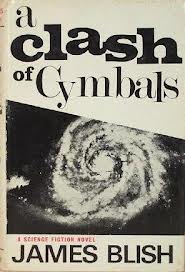
In James Blish's The Triumph Of Time/A Clash Of Cymbals, the Hevians and New Earthmen must send a probe, called Object 4101-Alephnull, into the anti-matter universe in order to measure its energy level and thus to predict the date of the cosmic collision.

The probe, like the first sputnik, Object 1957-a, is named after the year in which it was launched. This date was revised from 4001 to 4101 in later editions of the novel but, through an oversight, the title of the relevant chapter was not revised accordingly. Thus, in Cities In Flight (London, 1981), Object 4101-Alephnull is launched in CHAPTER SIX: Object 4001-Alephnull.

A mere additional century was in no way sufficient to overcome the chronological discrepancy between Volume III, Earthman, Come Home, which implies thousands of years of interstellar flight, and Volume IV, The Triumph Of Time, in which Blish echoed Bishop Ussher's 4004 BC cosmic creation date with his 4004 AD cosmic collision date.

The probe, "...a stable, electrically neutral, massless plasmoid...," has to be constructed, by what would now be called nanotechnology, from zero-spin particles and massless, chargeless neutrino/anti-neutrino pairs that are held inside an invisible, rotation- and magnetic spin-controlling spindizzy field which, made visible by a jet of smoke, appears to observers as a six foot bubble containing concentrations of electron gas, stripped nuclei, thermal neutrons and free radicals, with, at its center, a minute crystal of anti-salt (pp. 554-555). Blish makes the point that the particles are unvisualizable because they do not correspond to any macroscopic experience.

Nevertheless, the characters in Blish's Story, "Nor Iron Bars," do see an electron, probably by de Broglie waves. Gordon Arpe's interstellar drive is meant to repel a spaceship from Earth faster than light by giving it negative mass. However, negative mass can exist only in the microcosm so the ship collapses down to inside a carbon atom of a nearby object. Arpe and a companion land on an electron whose position is uncertain so that its surface resembles a waist-deep swirling substance. Further, the ship with negative mass must be echoed by an electron elsewhere in the universe. Switching of the drive restores positive mass, thus returning the ship to the macrocosm in that other part of the universe. And that is how the Arpe drive works. Unfortunately, this idea was not explored any further. The next story in that series involves a different kind of interstellar drive. And Blish said in conversation that Arpe's experiences, bizarre though they were, did not correspond to the real microcosm.

Meanwhile, The Triumph Of Time takes us back from the microcosm to the macrocosm. Like Poul Anderson's Tau Zero, this novel addresses the question: if stars are grouped into galaxies, then what are galaxies grouped into? - although the answer given here is slightly different. The "inner metagalaxy," comprising about fifty galaxies, including the Milky Way and the Andromeda, revolves "...in spiral arms around a common center of density..." (p. 576) Such metagalaxies form spiral arms around the metagalactic center from which the Saturn-sized monobloc had exploded.

Flying their planet to the metagalactic center, the Hevians and their companions occasionally glimpse a distant galaxy but do not see any of the "...tenuous bridges of stars which connected the galaxies..." (p. 577). Poul Anderson in World Without Stars describes isolated red dwarfs in intergalactic space though not any "...bridges of stars..." Blish hoped to find a way to work the bridges into a story although there was the problem that traveling between galaxies by these bridges would not be any quicker than traveling direct. 

Religion In Cities In Flight

Pre-Okie period: the Believers, sort of Evangelical Jehovah's Witnesses;
Okie period: an inchoate paganism of "the gods of all stars";
Post-Okie period: the Warriors of God, led by Jorn the Apostle.

The tone of James Blish's Cities In Flight series is entirely secular. Readers and sympathetic characters alike regard the Believers and the Warriors as Fundamentalist fanatics. The end of the universe is a scientific problem and is addressed as adequately as it can be by scientists, philosophers and administrators, not by priests or prophets.

The pragmatist Mayor Amalfi realises that:

"...it would be fatal to expect [Jorn] to panic if he got a Dirac-'cast claiming to be from Satan -" (James Blish, A Clash Of Cymbals, London, 1959, p. 119)

It is difficult while reading that to remember that Blish's other main end of the world scenario, Black Easter/The Day After Judgement, is not science fiction (sf) but fantasy and does involve a personal appearance and speech by Satan himself, the Satan that was seen by Dante. That fantasy is part of a Trilogy that addresses the question of whether the desire for secular knowledge is evil from a spiritual/supernaturalist point of view. In fact, when we read Blish's secularist sf, theological issues recede.

I question two premises of The Triumph Of Time. Has there been enough time for planetary populations of farmers to grow up in the Greater Magellanic Cloud? And would they so quickly lose a scientific perspective that a Fundamentalism could become a military force?

The Augustinian Age

"...in a universe of normal entropy, the monobloc is intolerable and must explode; in a universe of negative entropy, the heat-death is intolerable and must condense." (James Blish, The Triumph Of Time, London, 1981, pp. 510-511)

So, if entropy periodically reverses, can each universe cyclically become the other?

"And out of one universe might come the other..." (p. 510)

However, Blish immediately seems to contradict this:

"What the visible, tangible universe had been like before the monobloc was, however, agreed to be forever unknowable." (p. 511)

He quotes St Augustine's joke. What was God doing before he created the universe? He was creating a Hell for people blasphemous enough to ask such questions! The joke has a point. If our universe is the first, then, by definition, there cannot be any record of anything previous to it. Again, if our universe is not the first but if the process of cosmic destruction and re-creation involved the reduction of mass and energy to their most basic components, then there cannot be any organised state of mass or energy that would constitute a record of previous cosmic states. So, although there are no questions that should not be asked, maybe there really are some that cannot be answered?

But we can still speculate that, before the monobloc, there was a negative entropy universe winding down.

I have not reread this far yet but, at some point, Blish's characters posit that each of them might be able to survive the cosmic collision in an isolated, sensorially deprived, bodiless form. This strikes me as both impossible and undesirable. Then they seem to forgot this idea and plan for something else. Some of the discussion is not meant to be understood by the lay reader. It simply shows us that those of the characters who are scientists are grappling with their task. But there are other times, like this, when the discussion seems to me to be internally inconsistent.

Another example: the Hevians first think that continuous creation seems to prove divine creation although Fred Hoyle, who originally postulated it, did not think that. However, the Hevians have a history of religious speculation so it is comprehensible that they would see it that way.

The Structures Of Flandry And Okies

Original Series
Flandry: seven stories, collected in two volumes.
Okies: four stories, collected in one volume; Okie civilisation ends in the third so the fourth is an aftermath.

Works Written Later But Set Earlier
Flandry: three "Young Flandry" novels.
Okies: one prequel and one juvenile novel.

Works Set Later
Flandry: two later Flandry novels; one novel about his daughter; four works set after the Empire = one novel + one collection(?)
Okies: one novel about the end of the universe.

Related Works
Flandry: the earlier Technic History.
Okies: other series with related ideas.

Qualitatively though not quantitatively comparable.

What Is The End Of The World?

(A Clash Of Cymbals was the Faber & Faber edition of The Triumph Of Time.)

In The Triumph Of Time (Cities In Flight, London, 1981, p. 506), Dr Schloss says that, philosophically, either the universe will end or it will not. If it is going to end, then all that remains is to fix the date and, in the novel, the Hevians have begun to do this. He adds that cyclical theories are hedges.

If that is the case, then the entire novel is a hedge because the characters immediately pass from discussing the end of time itself to discussing an unexpected catastrophe at the midpoint of a cosmic cycle. However, on reflection, I see their point.

We must distinguish between:

(i) any ending, eg, an individual death, the fall of a civilisation, the end of all life on Earth etc;
(ii) the heat death of the universe, cosmic quiescence, when all the energy has run downhill and cannot (?) be made to run back up again;
(iii) a cessation of all existence.

Conservation laws teach us to expect (ii) though not (iii). Life teaches us to expect many cases of (i), ultimately, for each of us, our own individual deaths.

In the novel, the expected collision between matter and anti-matter universes is neither (iii) nor even (ii) but a spectacular example of (i). Matter will not cease to exist but will be transformed into energy on a scale to dwarf even the monobloc (p. 515). Because all the energy will remain not only existent but also extremely active, this event is not the heat death of the universe but must be midway between the monobloc and the heat death.

However, it is certainly an end to all life, consciousness, civilisation, organised matter and historical records - except that the interstellar empire called the Web of Hercules, by controlling matter-anti-matter interactions, does manage to leave a record. Blish has already quoted from a subsequent history of the Milky Way so would be contradicting himself if he did not explain the existence of this history.

The Triumph Of Time

James Blish's The Triumph Of Time is cosmological fiction on two or maybe three levels. First, it is set entirely outside the Milky Way. The characters are all human beings but have permanently left their home galaxy. One group, the Hevians:

travels through four other galaxies, Andromeda, M-33 and the Lesser and Greater Magellanic Clouds;

considers the million light year journey to NGC 6822;

instead travels to the centre of the universe, here called the Metagalactic Centre.

Thus, they have freedom of movement in the three spatial dimensions of one four dimensional continuum.

Secondly, the characters freely theorise about a much vaster realm. Having detected in intergalactic space both the continuous creation of material hydrogen atoms and the arrival from elsewhere of anti-material hydrogen atoms, they postulate an anti-matter universe with a reverse arrow of time, although perhaps both arrows point the same way, downhill? Further, an astronomer postulates sixteen dimensions to contain both universes.

Thirdly, by occupying the Metagalactic Centre at the moment of the collision between the two universes, the members of one group each enter a different space within which they are able to create new universes from their own bodies so that the novel ends, "Creation began." (Blish, The Triumph Of Time, London, 1981, p. 596).

Friday, 15 March 2013

The Nursery Of Time

In Chapter Three, "The Nursery of Time," of James Blish's The Triumph Of Time (IN Cities In Flight, London, 1981), his characters discuss cosmology.

When the moving planet, He, stopped in intergalactic space to repair one of its "spindizzies," its faster than light antigravity drives, Hevian instruments detected hydrogen atoms beginning to exist, implying a non-cyclical steady state universe. However, listening more intently, the Hevians also detected anti-material hydrogen atoms arriving and being annihilated.

The astronomer Jake postulates a system of at least sixteen dimensions within which the matter and anti-matter universes are approaching and will annihilate each other. The Hevians refer to this imminent cosmic collision as the end of time but, for no reason that I can see, the philosopher Gifford Bonner instead describes the universes as colliding midway between the monobloc and the heat death. He says that several myths and philosophies allow for "'...such a break or discontinuity right in the middle of the span of existence...,'" adding that, "'...in Scandinavian mythology it was called the Ginnangu-Gap.'" (p. 515)

But it wasn't. Scandinavian mythology moved from the void of the Ginnangu-Gap in the beginning to the  destruction called the Ragnarok at the end. That end was followed by a new beginning but the Ginnangu-Gap had been the old beginning, not a midway point. Despite this, Blish's characters come to name their coming cosmic collision after the Ginnangu-Gap.

Bonner, a philosopher, not a physicist, asks whether the transformation of matter into energy will not be accompanied by a comparable transformation of energy into matter, followed by a recession of the universes. The Hevian Retma, having spoken earlier of the end of time itself, now wonders why a creation-interdestruction-destruction cycle "'...should have this ornamental waterspout of continuous creation attached to it...'" (p. 515) Why indeed? The speculation is interesting but difficult to follow.

Some of the discussion, for example about " '...t-tau relationships...t-time and tau-time...' " is too technical for me to follow. (p. 517) Is this tau the same as Poul Anderson's in Tau Zero?

Lastly (for the present), what a long way we have come from the near future speculation of They Shall Have Stars to the cosmological speculation of The Triumph Of Time.