Showing posts with label A Case Of Conscience. Show all posts

Saturday, 9 November 2013

Thermonuclear Warfare

I found passages in Poul Anderson's Thermonuclear Warfare (Derby, Connecticut, 1963) that were relevant to four of his fictional works:

Twilight World
"Kings Who Die"
The Psychotechnic History
Planet Of No Return

This passage:

"Many will object that the requirements of an aggressive policy will lead to national regimentation, until we are hardly distinguishable from our opponents." (p. 153)

- is relevant to James Blish's Cities In Flight Tetralogy. In Volume I, set in the early twenty first century, American anti-Communism becomes as repressive as Russian anti-Fascism so that the two systems come to be indistinguishable and are bloodlessly united under a single Premier! - although this Spenglerian Fall of the West is preceded by the escape of a few Westerners from the Solar System in FTL spaceships. Centuries later, the Terrestrial Bureaucratic State falls when anti-gravity is rediscovered and entire cities are able to escape, seeking work among the Colonials.

Thus, this is a future in which thermonuclear war is prevented. The Russians conquer by stealth. Another Blish work, A Case Of Conscience, Volume III of the After Such Knowledge Trilogy, presents a different outcome of the Cold War. The arms race leads to a Shelter Race until the entire population lives permanently in subterranean cities where there are Corridor Riots. Anderson discusses shelters in Thermonuclear Warfare but does not suggest permanent life underground.

Anderson hoped that the Soviet Union would be defeated by persistent limited wars whereas instead its inefficient command economy was bankrupted by its self-imposed arms race.

Friday, 5 April 2013

Two Haertels; Four Histories

There are two versions of James Blish's fictitious character, Adolph Haertel:

Haertel I appears in "Common Time" and is referred to in the divergent timelines of "Nor Iron Bars," A Case Of Conscience and the Jack Loftus diptych;

Haertel II appears in Welcome To Mars and is referred to in The Quincunx Of Time.

In 2011, Haertel I showed that Einstein's relativity was only a special case of Milne's which was only a special case of Haertel's. The faster-than-light overdrive was constructed in 2030 as a result of "...Haertel's pencil-and-paper achievement..." (Mission To The Heart Stars, London, 1980, p. 48).

Haertel II's achievement was not merely with pencil and paper. At the age of seventeen, he discovered antigravity and flew a tree hut to Mars. Since The Quincunx Of Time describes Haertel as having made an important discovery at seventeen, I identify the Haertels of these two novels rather than postulating a third.

Haertel is referred to in different timelines just as we can expect Einstein to be.

Tuesday, 2 April 2013

Divergences

(i) In "Common Time," Garrard makes an interstellar round trip with the Haertel overdrive and confers with Haertel on his return.

(ii) In "Nor Iron Bars," the Arpe drive replaces the Haertel drive.

(iii) In "This Earth Of Hours," in the further future, Terrestrials representing a Matriarchy and using the Standing Wave, which has replaced the two earlier drives, encounter the civilization at the galactic center, which is called the Central Empire.

(iv) In The Star Dwellers, in the near future, the Haertel drive is called the Standing Wave.

(v) In Mission To The Heart Stars, Terrestrials, representing a peaceful UN world government and using the Haertel drive/Standing Wave, encounter the civilization in the galactic center, which is called the Hegemony of Malis, and discuss Garrard's journey.

(vi) In "A Dusk Of Idols," in the further future, the events of The Star Dwellers are referred back to.

(vii) In A Case Of Conscience, in the near future, Terrestrials, representing a nuclear shelter-based UN world government, use the Haertel drive and discuss Garrard's journey.

Clearly, these works have both continuities and divergences:

(i)-(iii) are the Galactic Cluster trilogy;
(iv)-(vi) are the "Heart Stars" trilogy;
(vii) is Volume III of the After Such Knowledge Trilogy, which starts not with Adolph Haertel in the future but with Roger Bacon in the past.

Mission To The Heart Stars mentions every aspect of Garrard's experience:

his subjective time variations;
the "psuedo-death";
the mysterious aliens encountered.

Thus, appropriately, "Common Time" fits both as the opening story of Galactic Cluster and as a Prelude to a Heart Stars collection. "Common Time," the pivotal events of the two novels and "A Dusk Of Idols" set in a further future would make an impressive "future history" volume.

Thursday, 27 September 2012

Two Masters Of All The Genres

Poul Anderson mastered historical fiction, science fiction (sf) and fantasy and even set one novel in each of these genres in the fourteenth century with a minor connection between the historical novel, Rogue Sword, and the sf novel, The High Crusade. (See an earlier post on Poul Anderson Appreciation, "Finding an Unexpected Connection" by Sean M Brooks, Wednesday, 9 May, 2012. Also here.)

James Blish, with a much smaller output, not only mastered these three genres but also went one step further than Anderson or any other author by writing a three genre Trilogy, After Such Knowledge:

in Volume I, Doctor Mirabilis (a historical novel), Roger Bacon, the founder of scientific method, is suspected of witchcraft and has a drug-induced vision of Armageddon;

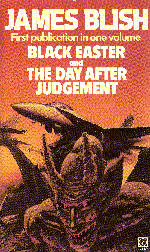
in Volume II, (a) Black Easter and (b) The Day After Judgement (contemporary fantasies), magicians release and cannot recall demons who then wage and win Armageddon;

in Volume III, A Case Of Conscience (futuristic sf), experiences on an extra-solar planet oblige a Jesuit biologist to ask heretical questions about the relative powers of God and Satan and to fear an imminent Armageddon.

The Trilogy is thematic, not linear, so it does not matter that Armageddon happens in the late twentieth century yet is still to happen in the mid-twenty first century - although this discrepancy might be resolved by the conclusion of The Day After Judgement, when Satan/God undoes (at least some of) the damage caused by the conflict in order to initiate a long development of mankind towards Godhood. This development could still be occurring in Volume III although, as was the case after the Armageddon in Volume II, the characters' mind-sets have not progressed yet.

The unifying theme of the Trilogy is the question whether the desire for secular knowledge is evil. Blish, like Anderson or any other scientifically trained hard sf writer, answered "No" but he managed to write a Trilogy about the question.

Anderson addressed a single theme in different genres when he presented the original of Odin in a historical novel, a time traveler mistaken for Odin in an sf story and Odin in three fantasy novels. However, this single theme does not make these works a single series. Instead, the contrasting treatments differentiate them as distinct works.

I was reminded of Black Easter, the definitive novel of demonic conjuration, when I read Anderson's account of Queen Skuld's ritual cursing in Hrolf Kraki's Saga. Pagan witchcraft was followed by Christian witchcraft which led, in Blish's fantasy, to Armageddon.

Sunday, 19 August 2012

Haertel Scholium Coda Contents

Earlier, Shorter Versions
"A Case Of Conscience": A Case Of Conscience.
"Beep": The Quincunx Of Time.
"A Hero's Life": "A Style In Treason."

Connected Works
 "No Jokes On Mars" connects with Welcome To Mars.
"A Dusk Of Idols": The Star Dwellers.
"And Some Were Savages": "This Earth Of Hours."

One Other
"How Beautiful With Banners" was originally to have referred to Martian dune cats.

Sunday, 17 June 2012

ASK Haertel

Works by James Blish referring to his character Adolph Haertel can be grouped as follows.

The Star Dwellers and Mission To The Heart Stars are the Jack Loftus diptych.

"Common Time," "Nor Iron Bars" and "This Earth Of Hours" are the Galactic Cluster trilogy. (They form a linear sequence and are collected in a volume of that title.)

A Case Of Conscience (ACOC) is Volume III of the After Such Knowledge (ASK) Trilogy. (ASK Vol I, Doctor Mirabilis, and Vol II, Black Easter/The Day After Judgement, are respectively historical and contemporary, thus pre-Haertel.)

Welcome To Mars, The Quincunx Of Time, "A Style In Treason" and Midsummer Century are an untitled tetralogy.

Haertel, young in Welcome To Mars and old in "Common Time," is referred back to by:

Loftus in his diptych;
Arpe in "Nor Iron Bars";
Ruiz-Sanchez in A Case Of Conscience;
Wald in The Quincunx Of Time.

"This Earth Of Hours" refers back to Arpe. The future civilizations of "A Style In Treason" and Midsummer Century transmit Dirac messages received earlier by Wald. In true future historical style, a planet in The Quincunx Of Time is named after a planetary explorer in "Nor Iron Bars." (Quincunx is a novelization of  "Beep" which had been collected in Galactic Cluster, the British edition of which excluded "This Earth Of Hours" so that I originally regarded "Beep" as completing this trilogy.)

Thus, the Haertel Scholium comprises one single volume, one diptych, one trilogy and one tetralogy plus some loose ends:

a short story loosely connected to Welcome To Mars;
another, "A Dusk Of Idols" (see Anywhen cover, below), connected to The Star Dwellers;
earlier, shorter versions of Quincunx and "A Style In Treason."

Works are linked by:

Arpe and Wald, each appearing once;
Haertel and Loftus, each appearing twice;
conflict between sacred and secular knowledge, addressed thrice.

The characters' legacies are:

Roger Bacon in ASK I: scientific method;

magicians in ASK II: a changed relationship to deity;

Haertel and Arpe: interstellar drives, named after them;

Arpe: microcosmic exploration and the discovery that psi forces are characteristic of subatomic space as electromagnetism is of macrocosmic space;

Ruiz-Sanchez: the theological problem of sinless but Godless aliens;

Petard, also in ASK III: his instantaneous communicator, the circum-continuum radio (CirCon);

Wald: (i) his instantaneous communicator, named after Paul Dirac, which, unlike Petard's, receives messages not only from the present but also from the past and future; (ii) a metalanguage for scientific paradigms and multiple dimensions;

Loftus: the Haertel overdrive-using UN, dolphins, extrasolar races and star dwelling energy beings allied against the Heart Stars Empire;

the Traitor in Chief of High Earth in "A Style In Treason": Earth and colonies, using a post-Haertel Imaginary Drive, allied against the Green Exarchy Empire;

Oberholzer in "This Earth Of Hours": the Terrestrial Matriarchy, using a post-Arpe Standing Wave, mobilized against the telepathic Central Empire;

Martels in Midsummer Century: a telepathically guided "Rebirth" of human civilization mobilized against an evolutionary challenge from intelligent Birds.

Thus, ASK and Haertel present:

two theories of telepathy (Arpe's and Martels');
two instantaneous communicators (Circon and Dirac);
three theology-science conflicts (Bacon, magicians and Ruiz-Sanchez);
three interstellar empires (Heart Stars, Green Exarchy and Central Empire);
four interstellar drives (Haertel, Arpe, Imaginary Drive and Standing Wave).

Circon, reaching around the continuum, detects and replies to radio waves currently transmitted light years away whereas the Dirac communicator controls the placement of an electron in the circuits of another Dirac communicator by controlling the frequency and path of a positron moving through a crystal lattice accompanied by de Broglie waves which are transforms of the waves of the electron so that a message is received by amplifying the bursts and reading the signal.

Thus:

Dirac is not radio;
its effect is simultaneous, not wave-like;
CirCon and Dirac are not two names for the same device.

Bacon, wrongly accused of magic, is the historical forerunner of scientists including:

in our era, Einstein and Dirac;
in several Blish futures, Haertel;
in different Haertel futures, Petard and Wald.

Blish's imagined scenarios are both extrapolative and exotic. ASK and Haertel are not a continuous sequence, except for ACOC, but Haertel etc as scientists are Bacon's successors.

Blish appropriately extends the theology-science issue from a medieval monk in ASK I through modern magicians in ASK II to a future Jesuit biologist and an atheist physicist in ASK III. However, despite the seriousness with which Blish treats this issue here, all his other fictitious scientists simply expand human knowledge of the galaxy, the universe, the microcosm and space-time without being troubled by theology.

Ruiz-Sanchez's contemporary, Petard, a lapsed Catholic, parallels the entirely secular Wald's invention of an instantaneous communicator but Wald goes further by also inventing a metalanguage for discussing the succession of scientific paradigms that had been initiated by Bacon in Doctor Mirabilis.

Doctor Mirabilis can therefore be regarded not only as Volume I of ASK but also as a prequel to Blish's various sf series and, in fact, John Amalfi, the central character of Blish's non-Haertel Cities In Flight Tetralogy, does appropriately refer to Bacon when discussing the scientifically predicted imminent end of the universe which, of course, revives theological concerns in some other characters although the title of Cities In Flight Vol IV, The Triumph Of Time, conveys the entirely secular view that time, not eternity, is the final arbiter of human destiny.

This article began as an attempt to group together the works of the Haertel Scholium but, because that Scholium overlaps with the After Such Knowledge Trilogy, it became a discussion of that Trilogy in relation both to the Scholium and to the Cities In Flight Tetralogy. For completeness, we should also mention Blish's shorter tetralogy collected as The Seedling Stars.

In Book Two of The Seedling Stars, extrasolar colonists, temporarily separated from terrestrial scientists, revive the conflict between sacred (scriptural) and secular (scientific) knowledge. In Book Three, the pilot of a crashed spaceship remarks that, if he were a religious man (which clearly he is not), he would think that the crash resulted from divine vengeance for the hubris of trying to seed the galaxy with Adapted Men. He and his fellow "pantropists" play the god-like role of designing microscopic human beings to inhabit water pools on the planet where they have crashed.

In Book Four, Adapted Men have spread throughout the galaxy without encountering any divine vengeance or, as far as we can see, experiencing any further religious qualms although the pagan expletive, "gods of all stars," familiar from Cities In Flight, remains in use. Lithia, the planet whose sinless but Godless inhabitants had disturbed Ruiz-Sanchez, is mentioned. Destroyed by human interventions in 2050 in ACOC, Lithia exists unchanged millennia later in The Seedling Stars so Ruiz-Sanchez's conflicts have not occurred in the essentially secular history of this alternative timeline.

The Dirac transmitter first appeared in the Okie series that became Cities In Flight but the transmitter's capacity to receive messages from the future would not have fitted into Okie culture, where cities fly into the unknown, so it had to be developed separately in one of the Haertel timelines. Similarly, the Okies, interstellar traders, and the Adapted Men, extrasolar colonists, could have complemented each other in a single series but Blish wanted to show that the Okies, despite their anti-agathics, would not live forever and demonstrated this drastically by ending the universe in 4004 whereas the Adapted Men needed much longer to colonize the galaxy so these two series necessarily diverged despite some early common references:

a pantropist refers to the Okie currency, the Oc dollar;
pantropists, like Okies and Wald, have the faster than light ultraphone.

Okies and Wald, but not pantropists, have the instantaneous Dirac transmitter but only Wald and his colleagues receive the Dirac "beep" containing messages from the future and including messages from later stories. Thus, one potential series became three distinct series whose defining technologies are:

"spindizzies," gravitron polarity generators, moving spaceships and cities through space faster than light, later moving a planet between galaxies and to the Metagalactic Centre;

pantropy, adapting human beings to other planets;

the Dirac communicator, receiving Dirac messages transmitted from any other point in space-time.

The text of  "A Style In Treason," and even the Dirac message received from that period, assume faster than light but not instantaneous communication, ultraphone but not Dirac. However, the politics of the period are somehow based on institutionalized deception and Blish would have been able to resolve any inconsistencies in his projected High Earth/Traitors' Guild/Green Exarchy novel.

The various series are also differentiated by their beginnings. Blish laid a sound basis for each series by describing the discoveries underlying his characters' later activities:

antigravity in "Bridge," incorporated into Cities In Flight, Vol I;
anti-agathics in "At Death's End," also incorporated into CIF, Vol I;
pantropy in The Seedling Stars, Book One;
antigravity, this time discovered by Haertel, in Welcome To Mars;
test flight of the Haertel overdrive in "Common Time";
test flight of the Arpe Drive in "Nor Iron Bars";
the theory of telepathy that later accounts for the Central Empire, also in "Nor Iron Bars";
the Dirac transmitter in "Beep," novelized as The Quincunx Of Time;
scientific method in Doctor Mirabilis.

Blish did not envisage any single political future:

when anti-gravity and antiagathics have been discovered and some extrasolar planets colonized, Russia wins the Cold War and bans space travel but, later, with anti-gravity rediscovered and the Vegan Tyranny defeated, a new confederation, roughly based on the former UN, rules Arm II until replaced by the Web of Hercules although New Earthmen continue to control the Greater Magellanic Cloud and the planet He explores the Andromeda galaxy;

the Greater Earth Port Authority, so enriched by tolls that its police force has absorbed the United States armed forces, aims to charge landing fees on terraformed planets and nearly suppresses pantropy but Adapted Men escape and occupy the galaxy;

ACOC's UN has imposed a world government in response to Corridor Riots in the self-sufficient city-sized underground nuclear air raid shelters controlled by Target Area Authorities derived from self-policing port authorities;

Loftus' UN world government, which controls a high-energy culture maintaining a large unemployed majority in comfort but not allowing them to vote or procreate, learns that the Heart Stars is a stagnant tyranny and allies with other races against it;

in Oberholzer's future, sperm electrophoresis enables parents to predetermine children's sex, causing a glut of males and a Matriarchy which discovers that planets of Population I stars in the galactic center and the clusters are populated by beings with hive mentalities and ganglia instead of brains and who regard brains as tumors so are hostile to the brained inhabitants of planets of Population II stars like Sol;

in the High Earth period, neither the ultraphone nor the Imaginary Drive permits hegemony over more than ten light years but a uniform interstellar economy is maintained with traitors as brokers in a bourse where planets seek financial advantage although half of the human worlds are ruled by the Green Exarch which draws tithes from six fallen empires older than man;

Wald's successors in the Earth intelligence bureau foresee themselves preventing disasters and presiding over peaceful intergalactic expansion, then do what they have foreseen themselves doing. (As Brian Aldiss wrote in an Introduction to The Quincunx Of Time, this novel really is about the future. Not only do we read about a fictitious future but the characters receive a series of messages from different periods of their future.)

These are seven very differently imagined futures although the High Earth-Green Exarchy conflict is supposed to be incorporated somehow into the peaceful expansion supervised by Wald's successors - unless, contradicting both their theory and their policy, this Dirac message turns out after all to originate from a merely potential future which they prevent instead of causing? (I don't think so but there you are.) 

ASK, Haertel, Okies and pantropy are not one series but they are a single coherent body of work: one diptych, two trilogies and three tetralogies. Uniform editions could comprise six volumes including a revised Galactic Cluster containing the short trilogy and the "loose ends."

"It was not until 2011 that the great Haertel succeeded..." (1)

Haertel's achievements, not necessarily mutually compatible, were:

to incorporate Einstein's relativity into Milne's and Milne's into his own (he did this in 2011, last year!);

to prove that there is only one fundamental particle;

to assume at the age of seventeen that a Pythagorean geometry of points, not a Euclidean geometry of lines, applies to ultimate particles like positrons;

also at age seventeen, to discover anti-gravity and fly a tree hut to Mars.

Loftus' mentor regards Haertel as the greatest theoretical physicist ever and Wald sometimes thinks that he must have been God so it is unsurprising that he is prominent in several timelines.

(1) Blish, James, Mission To The Heart Stars, London, 1980, p. 48.

Tuesday, 24 April 2012

James Blish: Symbols and Anagrams

William Atheling, Jr. and David Ketterer discuss symbolism in James Blish’s works. (Atheling was Blish’s pen-name when writing sf criticism.)
Blish’s “A Case of Conscience” ends with a slamming door (“Cleaver’s trade-mark”), thus implying the success of Cleaver’s view point even though the author had intended greater ambiguity.1 In Black Easter, light falling through a stained glass window onto a computer symbolises sacred versus secular knowledge, especially when the light from the window is said to mock the computer’s safe-lights.2
 
Other alleged symbols are less obvious. In “A Case of Conscience," when Fr. Ruiz-Sanchez, looking through a window, saw a “truncated tetrahedron of yellow light being cast out through…” the window, Blish intended the image to be metaphorical of Ruiz-Sanchez’s apartness from his three colleagues. The colleagues are the untruncated corners of the tetrahedron. David Ketterer rightly comments:

“…it is extremely unlikely that even the most perspicacious reader would understand the image in the way that Blish decoded it…”3
 
but adds:

“…Blish’s intended meaning is embedded in the choice of words and syntax.”3
 
Ketterer explains that Ruiz is connected to the light because he is looking out while it is being cast out and that “cast out” has religious connotations relevant to the issues estranging Ruiz from his secularist companions. I find this explanation less convincing than the interpretations of the slamming door and of the stained glass light on the computer.

In Blish’s other major work, Cities in Flight, the historian of Okie civilisation is ACREFF-MONALES. Is this name an anagram for SON-FORCE AMALFE, thus ensuring the transcendence of the Okie hero, Amalfi, despite the changed spelling of “Amalfi” and the extra “O” in the second phrase?4 Did Blish intend this anagram? Could it be valid even if he had not consciously intended it? I would not have thought so and cannot think of any way to answer these questions once they have been asked.

Blish’s “Get Out Of My Sky” features twin planets, Home and Rathe, whose names suggest another Blish title, Earthman, Come Home. Since Earth is humanity’s home planet and “Rathe” is an anagram, whether intended or not, for “Earth," I thought that the planets, both inhabited by humanoid beings, both symbolized Earth. However, Blish suggested in correspondence, then confirmed in conversation, that the names were inspired by Lewis Carroll (“mome rathes”).5

Without this auctorial explanation, I would have thought that Home/Rathe = Home/Earth was more plausible than ACREFF-MONALES = SON-FORCE AMALFE. If the rather obvious equation of Home/Rathe with Home/Earth was mistaken, then I am even less sure of the proposed interpretation of ACREFF-MONALES.

  1. William Atheling Jr., The Issue At Hand (Chicago: Advent Publishers, 1967), pp. 56-57.
  2. David Ketterer, Imprisoned In A Tesseract: the Life and Work of James Blish (Kent, Ohio, and London, England: The Kent University Press, 1987), p. 300.
  3. ibid, p. 86.
  4. ibid, pp. 190-191.
  5. ibid, p. 117.

James Blish: Haertel Histories

In A Case Of Conscience by James Blish, four terrestrial scientists visit a newly discovered and inhabited extrasolar planet called Lithia. They must recommend to the UN whether Lithia ought to be studied, exploited or quarantined. One of the scientists is a Jesuit, Fr. Ruiz-Sanchez. The Lithians contradict his Christian preconceptions so he regards them as diabolical and recommends quarantine.

David Ketterer writes:

“Somewhat startlingly, in view of the issue being confronted, the novel contains no references to other alien civilizations for purposes of comparison. But equally there are no references to the Lithians as the first alien civilization contacted. The reader is, however, left with the implication that other aliens have been encountered…by eliminating any direct allusion to this matter Blish might be said to have skewed the evidence by not presenting everything that is the case.”1

However, Ruiz’s colleague, Agronski, says:

“There aren’t any other planets. I mean, none with intelligent life on them that we’ve hit so far.”2
So Ruiz faces the problem of first contact without comparisons even though he refers to Garrard who, in “Common Time," had encountered incomprehensible aliens on the first successful interstellar flight but perhaps the UN had suppressed this information.3 In Mission to the Heart Stars, Garrard’s aliens, the beadmungen, will join an interstellar federation but that is in the future of a different history. Blish, like the more prolific Poul Anderson, gives the impression of considering every possibility along divergent timelines.

Agronski does refer to extraterrestrial animals. He continues:

“You can’t enslave a Martian sand crab.”2
 
Agronski does not mention, because Blish had not written this yet, that Garrard’s mentor, Haertel, found on Mars not sand crabs but tool- and language-using “dune-cats," which had been domesticated by a dying dominant race.4 Later, some Earthmen, regarding the cats as animals, fatally exploited them so that, by Agronski’s time, they might be either extinct or hiding.5 Thus, we can harmonize disparate stories.
On the other hand, Welcome to Mars, about Haertel on Mars, explains the Martian “canals” as faults or cracks caused by meteor impacts whereas “No Jokes on Mars," about exploited “dune cats," returns to the common sf idea of extinct Martian canal-builders, here called “Canal Masons." In Mission to the Heart Stars (a Haertel overdrive novel) and They Shall Have Stars (an Okie novel), the extinct Martians had tried to halt their planet’s decline by covering its surface with a “Diagram of Power," perceived as “canals” from Earth.6,7
This Martian “magic” not only did not work but also diverted resources from any effective survival efforts. In the Haertel history, the Heart Stars federation had dispassionately watched the construction of the Diagram of Power whereas, in the Okie history, there probably were no galactic observers that far back. In any case, the timelines diverge.
In Blish’s Fallen Star, Elvers claims to be a Martian but is probably a psychotic in which case his explanation of the “canals” as volcanic faults, caused when the Martians applied the force that destroyed the asteroidal protoplanets, is a fiction within the fiction.8 Blish, like Wells, Lewis and others, has more than one version of Mars and, as with Wells, one of the versions exists only in a character’s mind.

However, Blish maintains ambiguity:

his Doctor Mirabilis remains ambiguous as to whether its central character’s inner voice is psychological or demonic;
 
A Case of Conscience
remains ambiguous as to whether the Lithians’ origin and destruction are natural or supernatural;

 
Fallen Star,
midway between mainstream fiction and sf, ends with an exploratory space fleet about to be launched towards Mars but does not go on to tell us whether the fleet will find the expected lifeless planet or will instead confirm Elvers’ account.


If, as Ketterer suggests, it is the narrator, Julian Cole, who is insane so that:

“…Elvers the Martian is part of Julian’s delusion…”9

then Elvers’ devastated Mars with its genocidal inhabitants is a fiction within the fiction within the fiction: we read a novel in which Julian imagines that Elvers claims to be a Martian.
Although A Case of Conscience presents the Lithian expedition as the first contact with alien intelligences, its references to Haertel and Garrard evoke the rich history of Blish’s other fictions about aliens. Dune-cats, beadmungen, Lithians and “Angels” (space-dwelling energy beings), originally appearing in different stories or novels, each became background material for later works. If we read related Blish stories and novels in publication order, then we first encounter the elderly Haertel and his experimental overdrive in “Common Time."

We then see the Haertel overdrive in regular use in A Case of Conscience, in the “Angels” novels and in The Quincunx of Time although it was replaced by the Arpe Drive in “Nor Iron Bars," then by the Standing Wave in “This Earth of Hours” and possibly by the Imaginary Drive in “A Style in Treason."10 We first see a Martian dune-cat in “No Jokes on Mars." Finally, we learn, in Welcome to Mars, that the young Haertel had discovered antigravity and a Martian paw print.

There are other connections between works:

Lithia provides background material for “Watershed”;11

Angels and Heart Stars provide background material for “A Dusk of Idols”;12

Dirac messages link The Quincunx of Time to “A Style in Treason” and to Midsummer Century;13

the explorer who seeks protoplanet fragments at the North Pole in Fallen Star had previously sought the legendary mokele-mbembe in Africa although Blish readers know that those surviving dinosaurs had died fifty years earlier in The Night Shapes.14


Thus, Blish’s works provide substantial background material for each other without necessarily forming a linear series although he wrote those as well.

  1. David Ketterer, Imprisoned In A Tesseract: the life and work of James Blish (Kent, Ohio: The Kent State University Press, 1987), pp. 99-100.
  2. James Blish, A Case Of Conscience (Harmondsworth, Middlesex: Penguin Books, 1963), p. 67.
  3. James Blish, “Common Time” in Blish, Galactic Cluster (London: The New English Library Limited, 1963), pp. 7-28.
  4. James Blish, Welcome To Mars (London: Sphere Books Limited, 1978).
  5. James Blish, “No Jokes On Mars” in Blish, Anywhen (New York: Doubleday & Company, Inc, 1970), pp. 143-168.
  6. James Blish, Mission To The Heart Stars (London: Granada Publishing Limited, 1908).
  7. James Blish, They Shall Have Stars in Blish, Cities In Flight (London: Arrow Books Limited, 1981), pp. 7-129.
  8. James Blish, Fallen Star (London: Faber and Faber, 1957), p. 186.
  9. Ketterer, op. cit., p. 122.
  10. James Blish, The Star Dwellers (London: Sphere Books Limited, 1979); Mission To The Heart Stars; The Quincunx Of Time (New York: Dell Publishing Co., Inc, 1973); “Nor Iron Bars” in Galactic Cluster, pp. 61-92.; “This Earth Of Hours” and “A Style In Treason” in Blish, The Best Of James Blish (New York: Ballantine Books, 1979), pp. 257-280 and 313-348.
  11. James Blish, “Watershed” in Blish, The Seedling Stars (London: Arrow Books, 1972), pp. 182-192.
  12. James Blish, “A Dusk Of Idols” in Anywhen, pp. 105-135.
  13. James Blish, Midsummer Century (London: Arrow Books Ltd, 1975).
  14. James Blish, The Night Shapes (London: The New English Library Limited, 1965).