Showing posts with label Welcome To Mars. Show all posts

Monday, 26 October 2015

One Story Grows Into An Exotic Future History

Perhaps the most exotic fictitious future in sf was created by James Blish: a timeline extending from Haertel surviving on Mars to Martels' disembodied consciousness surviving inside a computer. Between these two end points is Thor Wald, (scroll down) revering Haertel and receiving a Dirac message (and see here) sent to Martels' computer. The timeline contains quite a few other exotica, including a High Earth/Traitors' Guild/Green Exarchy period (and see here) and a world-line cruiser traveling from 8873 to 8704 along the world-line of a planet on the rim of a galaxy eleven million light years away.

This bizarre future history grew in two stages. First, the single story, "Beep," featuring Thor Wald, set in our future, includes messages from several further futures. Secondly, when "Beep" was expanded as The Quincunx Of Time, connections to three other works were added:

Welcome To Mars (Haertel);
"A Style in Treason" (The Traitors' Guild etc);
Midsummer Century (Martels).

Since Midsummer Century was being written while "Beep" was being expanded, a reference to Wald was included in ...Century.

The result is neither a pyramidal future history like those of Heinlein and Anderson nor a more linear sequence like Blish's own Cities In Flight or The Seedling Stars. Instead, several otherwise independent works have been interestingly connected.

Tuesday, 14 May 2013

Films II

(See previous post.)

The titles, Welcome To Mars and A Life For The Stars, express the ideas of interplanetary and interstellar travel, respectively. These works are two of James Blish's five juvenile novels. Since A Life For The Stars is also one volume of Blish's Cities In Flight or "Okies" tetralogy, we are talking about eight volumes in total.

I suggested that, for purposes of screen dramatization, Welcome To Mars could be reconceptualized as the prelude to the Okie series, thus replacing They Shall Have Stars since the latter was not going to be filmed. I have no idea whether anyone else considered this but it is an obvious implication in the circumstances.

This raises the question whether the remaining three juveniles could also have been fitted into such a film series. Answer: one yes, the other two no. The Lost Jet, set either in the present or in the very near future - "day after tomorrow" sort of thing -, features orbital space flight, the stage before either interplanetary or interstellar travel. Otherwise, there is no overt connection between these works but a connection could have been added on screen.

That leaves the Jack Loftus diptych, The Star Dwellers and Mission To The Heart Stars. Although, of course, these novels introduce new themes and ideas, they are structurally a sequel to the first Adolph Haertel story, "Common Time," explicitly referring back to the characters and events of that story. This does connect the diptych to Welcome To Mars but differentiates it from Cities In Flight. Loftus, flying a spaceship, not a city, contends with a Malan Hegemony, not with a Vegan Tyranny.

Also, intergalactic politics differ. In the Okie series, the planet He and the Web of Hercules, both originating within the Milky Way, contend at the Metagalactic Centre before an imminent cosmic collision whereas, in the Loftus novels, some of the energy beings called Angels date from the first twenty minutes of the universe while others were born later in the same processes that generate stars. The First Born possibly participated in the First Cause. The Angels have been allied to ten previous galactic federations, collapsed three of those galaxies and communicate between themselves throughout the universe into an indefinite future.

Thus, here are two alternative cosmic histories and potentially two spectacular film series.

Films

The Spindizzy
In James Blish's Cities In Flight, Volume I, They Shall Have Stars, an anti-gravity device, the Dillon-Waggoner graviton polarity generator, nicknamed the "spindizzy," is invented;

in Volume II, A Life For The Stars, spindizzies are used to fly cities between stars faster than light;

in Volume III, Earthman, Come Home, they also fly a planet between galaxies and two cities to the Greater Magellanic Cloud;

in Volume IV, The Triumph Of Time, they fly a planet not only between galaxies but also to the Metagalactic Centre.

The Haertel Overdrive
In Blish's Welcome To Mars, Adolph Haertel discovers anti-gravity and flies a tree hut to Mars;

in "Common Time" and later works, the Haertel overdrive flies spacecraft between stars faster than light.

Thus, the spindizzy and the Haertel overdrive are alternative interstellar drives.

Film Ideas
Proposed films based on Blish's works were:

Welcome To Mars;
A Life For The Stars;
The Space Witch, an original flying cities film for which Blish wrote a plot outline.

One way to tie these films together would have been to rename the spindizzy as the "Haertel graviton polarity generator."

Thursday, 25 April 2013

The Haertel History II

See The Haertel History.

By summarizing plot elements and background details, I have made four works, with some input from a fifth (see below), sound like a much longer Heinleinian future history with successive interplanetary and interstellar periods.

Haertel's anti-gravity device is not fuelled whereas the DFC-3 is. Therefore, the Haertel overdrive is not merely an interstellar application of Haertel's anti-gravity. The latter is his theoretical and practical discovery of the late 1980's whereas the former follows from his theoretical discovery of 2011 according to one of the Jack Loftus/Heart Stars novels. The Haertel and Loftus timelines diverge at some point which may be after 2011 in Terrestrial history but has to be much earlier in terms of galactic history because Loftus' galactic center is occupied by the ancient Hegemony of Malis, not by any telepathic "Central Empire."

There are similarities but also differences of which some can be incorporated into a single timeline whereas others cannot:

Loftus and his colleagues serve a UN world government in the mid-twenty first century, not a Matriarchy in the further future;

Like a handful of Matriarchy diplomats and Marines in that alternative future, Loftus and two other Earthmen make a long journey home to warn of a threat from a heart stars civilization;

their FTL drive is not a Standing Wave that has replaced the Haertel and Arpe drives but a modified Haertel overdrive that is called "the Standing Wave";

Loftus' mentor refers to Garrard's strange temporal experiences with the Haertel overdrive Mark I;

an "Angel" allied to the UN informs us that Earthmen have withdrawn in confusion from the Centaurian beadmungen.

Thus, even a novel set in an alternative scenario imparts some information about the primary Haertel timeline.

Having introduced and defined a galactic conflict between telepaths and their natural opponents, Blish saw no reason either to recount or to resolve the conflict. This sequence of stories would have been extended only if some later story idea had required a reference to the Matriarchy or to the Central Empire just as the story introducing them had required a reference back to Arpe's discovery of microcosmic telepathy and as Arpe in turn had referred back to Garrard as the first man to reach Alpha Centauri.

Wednesday, 24 April 2013

The Haertel History

One novel (Welcome To Mars) and three short stories ("Common Time," "Nor Iron Bars" and "This Earth Of Hours") generate a long sequence of fictitious historical events in a galactic context.

Cosmic Setting And Galactic Context

"Parapsychological fields" are part of the fine structure of subatomic space as electromagnetic fields are part of the fine structure of cosmic space. Therefore, telepathy is too weak to be detected, except fleetingly, by brains evolved to function on planetary surfaces. However, stellar radiation affects biological evolution. Any sentient organism that has evolved on a planet of a Population I star thinks not with a single brain but with multiple ganglia which are able to detect the weak field.

Such organisms communicate telepathically so that (i) a planetary population has a single identity and (ii) instantaneous telepathic communication unites the crowded galactic center into a "Central Empire" - although this terminology might be inappropriate both because there cannot be any individual Emperor and because military conquest of colony planets is unnecessary. (American sf authors became used to writing about interstellar "empires.")

Telepaths regard brained inhabitants of Population II planets, who fight, and eventually exterminate, each other, as diseased. The Central Empire, expanding along the spiral arms, finds natural allies in the clusters, where all the stars are Population I. Thus, mutually hostile Population II civilizations, will be outnumbered and surrounded by a united opponent...

The Future History

By the late 1980's, NASA has not yet landed anyone on the Moon;

Adolph "Dolph" Haertel discovers anti-gravity and flies a tree hut to Mars;

Nanette Ford follows Haertel to Mars;

knowledge of Haertel's discovery inspires the development of an ion drive;

a UN fleet reaches Mars by ion drive;

Dolph and Nanette meet an intelligent dune-cat and a last, dying member of the dominant Martian race;

("No Jokes On Mars" presents essentially the same vision of Mars differing in a few details);

in 2011, Haertel's theory, superseding Einstein's and Milne's relativity, allows faster than light (FTL) travel;

Brown in the Haertel overdrive spaceship DFC-1 leaves for Alpha Centauri but fails to return;

Cellini in DFC-2 suffers the same unknown fate as Brown;

Garrard in DFC-3, on the first round trip to Alpha Centauri, experiences problematic subjective effects of the overdrive and communicates incomprehensibly with indescribable Centaurians called "beadmungen," then, after returning home, discusses his experiences with Haertel;

ferries transport passengers between Satellite Vehicle 1 and larger, orbiting spacecraft;

3V comedienne Celia Gospardi regularly travels to shows on the Moon;

a spaceman named Oestreicher is captain of passenger ships to Mars for ten years;

Daryon Hammersmith "conquers Titan," according to newslines;

the Flyaway I takes twelve years to reach Alpha Centauri by ion drive;

Gordon Arpe invents a new FTL drive that involves giving a spaceship negative mass;

negative mass cannot exist in the macrocosm so Flyaway II (with Arpe as captain, Oestreicher as first officer and Gospardi and Hammersmith among its passengers) collapses into the microcosm where everyone on board becomes telepathic;

Arpe and Gospardi land on an electron;

a subatomic negative mass has to be echoed by an electron elsewhere so the ship occupies two locations simultaneously and, when the Arpe drive is switched off, returns to the macrocosm in the other location, eight hundred light years away from Sol and Alpha Centauri;

after a second microcosmic jump, the ship, no longer usable because its hull, expanded by each jump, now leaks badly, reaches Alpha Centauri;

the colonists retreat in confusion from the incomprehensible beadmungen;

an FTL drive called the Standing Wave replaces the Haertel and Arpe drives;

sperm electrophoresis enables parents to predetermine a child's sex, thus causing a glut of males;

Earth becomes a Matriarchy;

the Matriarchy becomes an interstellar military and colonial power;

Calle and Xixobrax, two planets of the Central Empire, destroy a large Matriarchy invasion fleet;

a small group of Earthmen begins a long journey home to warn about the threat from the Central Empire...

Blish leaves the issue there. Further comments to follow. (See here.)

Thursday, 18 April 2013

Complete Works Syndrome

With Poul Anderson and James Blish, I try to imagine an optimal reading order which is also potentially a way to repackage the volumes for any future Complete Works editions. Several of Blish's works fit together as two-volume sequences or "diptychs." Thus:

Welcome To Mars
the Galactic Cluster trilogy

The Star Dwellers
Mission To The Heart Stars

The Quincunx Of Time
Midsummer Century

Further, the Cities In Flight Tetralogy makes sense as a "double diptych":

They Shall Have Stars
A Life For The Stars

Earthman, Come Home
The Triumph Of Time

These four titles express or evoke a prelude, a life, a return and an ending, thus a complete Wagnerian Tetralogy. Neat.

Of the ten volumes listed here, five are adult novels, four are juvenile novels and one is a collection - in fact, a very short collection if we include only the "trilogy." Of the adult novels:

two are in fact amalgamations of shorter, previously published, works;
one is an expansion, still very short, of such a work;
and another, Midsummer Century, is itself very short, less than a hundred pages of text;
thus, perhaps only The Triumph Of Time is a full-length adult novel written as a unit.

Adolph Haertel, Jack Loftus and John Amalfi are, respectively, the unifying characters of the first, second and fifth diptychs listed above. The third diptych is unified by the presence of Thor Wald in the first volume and a reference to him in the second. The fourth is unified by the presence of Dillon and Wagonner in the first volume and the existence of the Dillon-Wagonner graviton polarity generator in the second.

Black Easter and The Day After Judgement formed a further diptych with a common cast of characters but came instead to be classified and published as a single novel and as Volume II of a Trilogy. Volume III, A Case Of Conscience, comprises "A Case Of Conscience," set on Lithia in 2049, expanded as Book One, and a continuation or sequel, set on Earth and the Moon in 2050, as Book Two. Thus, of the After Such Knowledge Trilogy, only Volume I, Doctor Mirabilis, was originally conceived as a single novel.

Thus, this "diptych" analysis has enabled us to summarize or survey the contents of Blish's Haertel Scholium, Cities In Flight and After Such Knowledge.

My motto is "There is always more."

Tuesday, 16 April 2013

Mars

Unfortunately, I think that Welcome To Mars and "No Jokes On Mars" are too incompatible to fit into a single timeline. Some editing would have become necessary if any attempt had been made to fit them into a Haertel equivalent of the Cities In Flight sequence.

The Martian desert, lichen and animals are identical in detail. However, "Jokes," informs us that it is sometimes suggested that the dune cat "...may be descended from the long-extinct Canal Masons of Mars..." (Anywhen, New York, 1970, p. 145), whereas, in Welcome, the "canals" are impact fissures around craters and the last member of the dominant Martian race died in front of the first man on Mars, Adolph Haertel.

Other than this, it is clearly the same vision of Mars in both works. Thus, some editing or further explanation would have sufficed to fit them into a single series.

Sunday, 14 April 2013

Something Basic

There is something very basic about James Blish's account of the meeting with the Hegemon of Malis in Mission To The Heart Stars but it took me a while to realize what it was:

our juvenile hero, his companion and their mentor enter an audience room so vast that its ceiling is not visible;

there are machines, no two alike, standing along the walls;

the three Earthmen must walk to where the Hegemon waits;

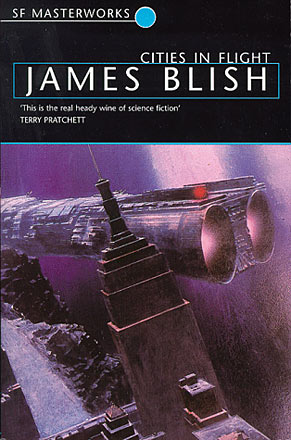
he is blue, humanoid, over eight feet tall and simply clad in black with bare arms and legs (see image of book cover);

guided both by ancient customs and by machines, he simply states that the Hegemony will forcibly incorporate humanity as a subject race.

On reflection, I realised that I would have accepted without question such an account of an alien contact when I was at primary school. Identifying with the young hero while imagining the companionship of both a peer and an elder, I would expect a hostile alien to be humanoid but menacingly large, also that his civilization would have the, for us, paradoxical features of ancientness, as represented by large, old buildings, and of high technology, as represented in this case by "machines" simply placed along the walls of the vast chamber.

This reads like an archetypal account of human-alien contact. Another such is Dolph Haertel's meeting with the last surviving member of the dominant race of Mars under Lacus Solis in Welcome To Mars.

Welcome To Mars: Conclusion

In James Blish's Welcome To Mars, before Dolph Haertel, then Nanette Ford, travel to Mars, NASA has not yet put anyone on the Moon. Over one Martian, two Terrestrial, years later, the Cold War has ended and a UN Space Force fleet reaches Mars.

The rapid deployment of such a fleet has become possible because:

Dolph's and Nanette's parents and one influential contact had remained irrationally convinced that "the children" were still alive on Mars;

the knowledge that Dolph had discovered antigravity had facilitated the development of an improved ion-drive for spaceships.

Is it either politically or technologically plausible that so much could be achieved so soon with so little? I think that it is as implausible as the Martian organisms that Dolph and Nanette find. Thus, either no one could survive on Mars long enough to be rescued or a very different story needs to be told about it.

I think that Jim Blish said that the film of Welcome To Mars would have shown Nanette giving birth on Mars although, of course, this does not happen in the juvenile novel.

Saturday, 13 April 2013

Martian Organisms

In James Blish's Welcome To Mars (London, 1978),

(i) lichen:

grows in limonite sands in the Martian craters;
cracks molecules of oxygen and water from the sands;
is spread by the wind like tumble weed;
feeds (ii) nematode- or worm-like organisms.

(iii) Black arthropods or mites eat the nematodes.

(iv) A hard-shelled burrowing invertebrate eats mites and nematodes and drinks from lichen.

(v) A large, intelligent, cat- or kangaroo-like organism whose forelegs have hands with opposible thumb eats invertebrates and browses on tumble-lichen. Another lichen on the dune-cat's hide "...drew nourishment from the cat's bloodstream, but it returned oxygen." (p. 132)

(vi)The floor of the crater Lacus Solis is ice that focuses sunlight into a cavern beneath it containing a dead crystalline city. In the city, an amphitheatre reflecting the light back at the sky contains a fourteen foot high, fluid-filled box on a stone dais. On a throne in the box sits a tall serpentine figure with several arms near the head. This last member of the dominant Martian race knows all Terrestrial languages from radio broadcasts.

This was all highly implausible even at the time of writing.

Friday, 12 April 2013

Survival On Mars II

See here.

In James Blish's Welcome To Mars (London, 1978), as soon as Dolph Haertel realises that he is stranded on Mars, he makes an inventory of all his resources, in Chapter 4.

(I am summarising this to confirm that it holds together.)

Oxygen: "He had started with five flasks, totalling...45 gallons..." (p. 42) One is probably almost empty after the journey (three days?) and less than one day on Mars. Dolph can leave his hut wearing respirator and goggles.

Water: "...three 17.5 gallon drums..." (p. 42). He would need to drink at least a gallon a day and would lose a gallon through evaporation.

Food: Two weeks' supply of K rations.

Power: Rechargeable batteries. Power needed for air pressure and heat and to electrolyze water (if found) for oxygen.

On his first full day on Mars, in Chapter 5, called "Morning on Mars," he:

locates and closes leaks;
makes an electric motor from metal and wire;
uses Sterno and blowpipe to make a pump from glass tubes and nails;
pumps Martian air into his hut so that he can slow the rate of oxygen use;
plans to build a generator with a magnetized steel rotor and to make windmill sails from canvas;
finds water in some of the Martian lichen sacs.

After this, I find that the chronology becomes uncertain. Chapter 6 is called "Evening on Mars" and seems to follow directly after Chapter 5. Nanette follows Dolph to Mars, with little delay it seems. Meanwhile, Dolph makes a wine press, uses lichen sap to keep his air moist and discovers that the apparently empty sacs contain oxygen. Collecting more lichen, he sees Nanette arrive.

Chapter 7 changes the scene to Earth where twenty nine days pass, after which it is believed that "the children" cannot still be alive on Mars. The chapter ends with Dolph rescuing Nanette from the wreck of her ship with the implication that he is doing this after the twenty nine days have elapsed. Chapter 8 confirms that he has been on Mars for weeks although he had only had two weeks of K rations and has not yet experimented with Martian food sources.

In any case, Nanette brings fresh supplies. Dolph goes on to learn that Martian lichen is not only edible but also slows the metabolism, thus reducing breathing, and he mines water.

Thursday, 11 April 2013

Welcome To Mars III

Jack Loftus stars in The Star Dwellers and in its immediate sequel, Mission To The Heart Stars;

Adolph Haertel stars in Welcome To Mars and appears in "Common Time," the first of three connected short stories in the collection, Galactic Cluster;

Thor Wald appears in The Quincunx Of Time and is referred to early in Midsummer Century.

Thus, there are three instances of two volumes linked by one character. Loftus and Wald also refer to Haertel but only in the same way as they refer to Einstein.

Haertel:

was introduced in "Common Time";

became a historical character common to alternative futures inhabited by Loftus, Wald and others (Arpe in "Nor Iron Bars" and Ruiz-Sanchez in A Case Of Conscience);

then, in a third and final stage, was adapted as the teenage hero of the juvenile novel Welcome To Mars - although we might ask whether this younger Haertel is quite consistent with any of the various older versions.

Mission To The Heart Stars was written after The Star Dwellers;
Galactic Cluster was written before Welcome To Mars;
Midsummer Century was written while "Beep" was being expanded as The Quincunx Of Time.

Non-technical readers usually trust the scientific information imparted in works of hard sf. In Welcome To Mars, we:

(i) understand that Haertel, in this work called "Dolph," has the urgent problem of how to survive indefinitely when marooned on Mars;
 
(ii) soon come to accept that he has solved this problem;

(iii) might come to wonder whether we have been given enough information to warrant the transition from (i) to (ii).

The information is there but maybe, for some of us, needed to be spelled out a bit more. More on this later. (See here.)

Wednesday, 10 April 2013

A Short Interstellar Trilogy

Three short stories by James Blish are a better written and more imaginative interstellar-themed science fiction trilogy than Isaac Asimov's famous Foundation Trilogy. This Blish trilogy, which can be called "Galactic Cluster" after the collection containing these stories among others, has a definite beginning, middle and end:

"Common Time": a first faster than light interstellar crossing with the Haertel overdrive;

"Nor Iron Bars": a second FTL crossing with the Arpe drive;
                        exploration of the microcosm with the Arpe drive;
                        discovery of the microcosmic basis of telepathy;

"This Earth Of Hours": FTL on the Standing Wave;
                                 early contact and conflict with a telepathic interstellar empire.

FTL, interstellar empire and mental powers are all familiar from Asimov but Blish does far more with these ideas in far fewer words.

Since "Common Time" features the scientist Adolph Haertel and since Blish's juvenile novel Welcome To Mars features the teenage Haertel, the latter volume can be seen as a prequel to the Galactic Cluster trilogy but there the linear sequence ends, with Blish's "Haertel Scholium" volumes presenting several alternative or divergent futures rather than a single series.

Because, in the Haertel Scholium, it is Thor Wald that invents the Dirac communicator and because Wald, while appearing in one volume, is referred to by name in another, he might count as the unifying character of his diptych as Adolph Haertel and Jack Loftus are of theirs.

I have yet to finish rereading and posting about Welcome To Mars but meanwhile wanted to commend the short trilogy to which it can be seen as a prequel.

Survival On Mars

In James Blish's Welcome To Mars (London, 1978), how do Dolph and Nanette manage to continue breathing, drinking and eating on Mars long after their imported supplies have run out? The Martian lichen, which grows all over the surface in the area where they have landed and which they manage to store in sufficient quantity during the long winter, provides oxygen, water and food. In fact, it is beneficial and invigorating. Would this single source suffice? And how plausible is it?

Writing in 1965, Blish tried not to contradict then known facts although new data were due from a Mariner probe and are noted in the Afterword. I think that such complex organisms were unlikely on Mars even then. Having got us to accept the lichen, Blish moves on to animals and even intelligence.

He wrote in the Foreword that Mars was:

 "...apparently the only other planet in the Solar System on which a brave man might just barely manage to stay alive, if he never stopped trying." (p. 10)

- but he gives his characters a lot of help and I do not think that his claim could be made of Mars now.

Tuesday, 9 April 2013

The Structure Of Welcome To Mars I

James Blish, Welcome To Mars (London,1978): three Parts, each with five chapters; chapters numbered 1 to 15.

Part One: On The Beach.
Chapter 1, The Tree House, ends as Dolph leaves Earth.
Chapter 2, The Sea of Streams, ends as Dolph approaches Mars.
Chapter 3, Down...and Out, ends with Dolph marooned on Mars.
Chapter 4, A Little Detection, Dolph's inventory; Nanette's deduction.
Chapter 5, Morning on Mars, first day on Mars.

Part Two: Friday.
Chapter 6, Evening on Mars, Nanette arrives.
Chapter 7, Children in the Sky, twenty-nine days after Dolph left.
Chapter 8, Wine and Storm, Nanette has just arrived but Dolph has been on Mars for weeks (p. 80)!

That is as far as I have reread. I am trying to resolve the chronology. There was a four-day weekend coming up. Dolph said he would go camping for at least one more day and he "...had accumulated the extra day off from school..." (p.23) "...at least one more day..." implies that he might be away for slightly longer than five days whereas "...extra day off from school..." implies an obligation to return after just five days. In any case, he should certainly not have been away for longer than a week.

"Nanette had noticed that the tree-house was missing, on the very morning of its departure." (p. 46)

Before following Dolph to Mars, she leaves a note for her and his parents, saying that he has not gone camping but has gone to Mars and that she has followed him. She must have left the note, before leaving Earth, shortly after realising that he had gone and within the five or so days when Dolph was believed to be camping.

The novel describes, in this order:

Dolph seeing Nanette's arrival on Mars (end of Chapter 6);
the "Children in the Sky" news story on Earth, ending twenty nine days after Dolph left Earth (Chapter 7);
Dolph rescuing the unconscious Nanette, with the auctorial comment, "For him, it was very clear, the case of the Children in the Sky was very far from over." (p. 77) (end of Chapter 7);
Nanette, the day after her arrival, finding "...the root of the irregularity in the pump cycle, which had been eluding him for weeks." (p. 80) (early in Chapter 8)

Has this chronology of fictitious events become inconsistent? I wish that I had read the text this closely while Blish was still alive.

Later: I did not address above the question of how long it takes Dolph and Nanette to travel to Mars. But the implication is that it is not long. Dolph intended to be away for about five days and:

"By the middle of his second day in space he was already slightly more than half-way there..." (p. 28)

Nanette should not have taken much longer and, in any case, could not have survived for weeks in space.

Welcome To Mars II

James Blish's Welcome To Mars (London, 1978) is a very unusual novel because it contains no conversations until almost exactly its midpoint. The novel ends on p. 154 and the conversation starts on p. 78 which would be nearly the midpoint except that the text of the novel starts on p. 13.

There are fifteen chapters but there is no conversation in the first seven. That is because the central character, Dolph Haertel, works alone and in secret as he discovers anti-gravity and flies a tree hut to Mars, where he is marooned. We are informed about his parents and a girl friend only by a narrative summary, not by any dialogue involving these characters.

When the girl friend, Nanette, deduces where Dolph has gone, follows him and is also marooned, she too has worked alone and in secret, without engaging in any conversations that are recounted to the reader. When the two sets of parents realize that Nanette's farewell note saying that they have gone to Mars is nothing less than the unvarnished truth, and try to arouse official and public interest in rescuing the stranded teenagers, we read a summary account of a news story and a publicity campaign but are not told any of the conversations that would have been involved.

Thus, the very first conversation in the novel is between Dolph and Nanette on Mars. I am reminded of the Prisoner episode, "Many Happy Returns," in which No 6, waking in a deserted Village, builds a raft, leaves the island, reaches an as yet unidentified mainland and first speaks to another character about midway between the two commercial breaks.

This Mars is not lifeless; there is vegetation. I am not sure of the chronology - Nanette seems to leave Earth soon after Dolph but to reach Mars much later - but I will have to reread to check.

Monday, 8 April 2013

Welcome To Mars

We can perceive any one book very differently. Some - the Bible, the Koran, The Origin of Species - are so influential that we acknowledge their significance and have some idea of their content, or message, even if we have never read them.

Of the books that we have read, it makes a difference whether we have merely read them once or twice in the past, have reread them recently or have studied them. Certain works by James Blish are almost designed to re-arrange themselves in our heads if they are reread or studied closely:

both Welcome To Mars and Galactic Cluster feature Adolph Haertel;

both The Star Dwellers and Mission To The Heart Stars feature Jack Loftus;

The Quincunx Of Time and Midsummer Century are linked by a "Dirac message";

of the four works mentioned here that do not feature Haertel, three nevertheless do refer to him, as does A Case Of Conscience;

thus, these seven volumes are closely interconnected without forming a linear sequence.

I am currently rereading Welcome To Mars (London, 1978). Having already introduced Haertel as an adult and a future equivalent of Einstein, Blish now tells us about Haertel's parents and his teenage years, when he is known as "Dolph." Mission To The Heart Stars describes Milne and Dingle as intermediate between Einstein and Haertel and Welcome To Mars shows us Haertel studying these intermediaries.

Milne died in 1950. This was "...nearly twenty years before Dolph's birth..." (p. 18). Let us call that eighteen or nineteen years. So Dolph is born in 1968 or '69.

"At the age of seventeen, Dolph Haertel had discovered anti-gravity." (p. 14)

- so that was in 1985 or '86. Blish's Foreword and Afterword are dated 1965 and the text of the novel assumes no Moon landing yet, not even by '85 or '86. Dolph, flying his tree hut to Mars, will be the first man on another planet.

Dolph discovers that gravity "...has polarity..." (pp. 18, 27) and therefore "...could be manipulated..." (p. 18). Although Haertel does not mention the Blacket-Dirac equations, gravitational polarity does sound like the graviton polarity generators, nicknamed "spindizzies," of Blish's Okies or Cities In Flight series and, in fact, Dolph's "...breadboard rig..." (p. 19) does indeed function like a mini-spindizzy by lifting the Haertel's garage an inch from the Earth, thus confirming that it is able to lift a smaller object into space.

There were plans to film two of Blish's juvenile works, this Haertel novel and the second Okie novel. If this had been done, might the two films have become a series with the Haertel overdrive and the Dillon-Waggoner graviton polarity generator merging into a single Haertel graviton polarity generator?

Finally, for this post, Haertel's device functions like Cavorite: Dolph leaves Earth by shutting out terrestrial gravity, then approaches Mars by letting in Martian gravity. Never forget Wells.

Sunday, 19 August 2012

Haertel Scholium Coda Contents

Earlier, Shorter Versions
"A Case Of Conscience": A Case Of Conscience.
"Beep": The Quincunx Of Time.
"A Hero's Life": "A Style In Treason."

Connected Works
 "No Jokes On Mars" connects with Welcome To Mars.
"A Dusk Of Idols": The Star Dwellers.
"And Some Were Savages": "This Earth Of Hours."

One Other
"How Beautiful With Banners" was originally to have referred to Martian dune cats.

Monday, 25 June 2012

Overlapping Trilogies

Not every trilogy is three long volumes. In the British edition of Galactic Cluster by James Blish, three short stories formed a linear sequence:

"Common Time":
an elderly Adolph Haertel and his faster than light overdrive, strange temporal experiences in the spaceship;

"Nor Iron Bars":
the Arpe drive replacing Haertel's,
a planetary explorer called Hammersmith,
microcosmic telepathy;

"Beep":
an unspecified faster than light drive,
a planet called Hammersmith,
the Dirac communicator,
a mention of "...time phenomena..." which I took to refer to "Common Time." (1)

However, the American edition of Galactic Cluster also included "This Earth Of Hours" which fits in more neatly with the first two stories, thus:

"Common Time" and "Nor Iron Bars": as above;
"This Earth Of Hours": the Standing Wave replacing both earlier interstellar drives, macrocosmic telepathy.

Apart from the single word "Hammersmith," "Beep" is really on its own. However, when it had been novelized as The Quincunx Of Time, it then formed a sequence with two other novels.

Welcome To Mars: the young Haertel discovering antigravity;
 
The Quincunx Of Time: as "Beep" but now with explicit references to the young Haertel and his overdrive;

Midsummer Century: the transmission of a Dirac message received earlier in The Quincunx Of Time.

Thus, we wind up with two trilogies connected by Haertel. Since another message received in Quincunx refers to "A Style In Treason," the second trilogy can be upgraded to a tetralogy.

Haertel is also mentioned in a juvenile diptych and in one volume of another trilogy (see earlier posts), but "Common Time" and Welcome To Mars are his only two appearances. In any "Complete Works of James Blish":

the tetralogy as above could be collected in a single volume;

Galactic Cluster could be revised to highlight the trilogy, to shed unrelated stories to other collections and to include Haertel Scholium "loose ends," connected stories that do not quite fit into any linear sequence.  

(1) Blish, James, "Beep" IN Blish, J., Galactic Cluster, London, 1963, pp. 93-128 AT p. 103.