Copied from Poul Anderson Appreciation:
Compare and contrast:
James Blish's four "pantropy" stories, collected as The Seedling Stars;
Poul Anderson's four post-Terran Empire stories, collected in The Long Night and again in Flandry's Legacy.
Both these tetralogies are hard sf with interstellar themes:
Blish's theme is artificial adaptation of human beings to extraterrestrial environments;
Anderson's theme is natural adaptations by human beings left isolated in extraterrestrial environments.
When I had explicitated this comparison, I realized why I had been thinking of these two series in parallel.
The pantropy series is a short but complete future history, covering:
an early interplanetary period;
intermediate periods on two extra-solar planets;
longer term galactic hegemony for humanity in its many adapted forms.
The post-Empire stories also cover a future historical period:
post-Imperial anarchy in the mid-fourth millennium;
an intermediate period while the Allied Planets restore interstellar civilization;
longer term, human civilizations have spread through several spiral arms and one is served by the Commonalty.
The
main difference is that the post-Empire stories are not complete in
themselves but are merely the concluding section of the much longer
History of Technic Civilization.
Friday, 27 June 2014
Saturday, 9 November 2013
Thermonuclear Warfare
I found passages in Poul Anderson's Thermonuclear Warfare (Derby, Connecticut, 1963) that were relevant to four of his fictional works:
Twilight World
"Kings Who Die"
The Psychotechnic History
Planet Of No Return
This passage:
"Many will object that the requirements of an aggressive policy will lead to national regimentation, until we are hardly distinguishable from our opponents." (p. 153)
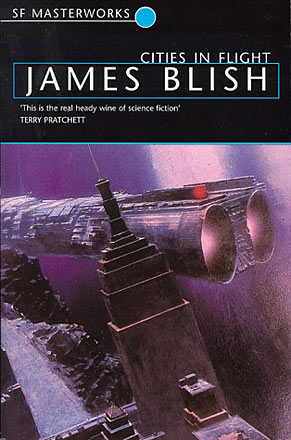
- is relevant to James Blish's Cities In Flight Tetralogy. In Volume I, set in the early twenty first century, American anti-Communism becomes as repressive as Russian anti-Fascism so that the two systems come to be indistinguishable and are bloodlessly united under a single Premier! - although this Spenglerian Fall of the West is preceded by the escape of a few Westerners from the Solar System in FTL spaceships. Centuries later, the Terrestrial Bureaucratic State falls when anti-gravity is rediscovered and entire cities are able to escape, seeking work among the Colonials.
Thus, this is a future in which thermonuclear war is prevented. The Russians conquer by stealth. Another Blish work, A Case Of Conscience, Volume III of the After Such Knowledge Trilogy, presents a different outcome of the Cold War. The arms race leads to a Shelter Race until the entire population lives permanently in subterranean cities where there are Corridor Riots. Anderson discusses shelters in Thermonuclear Warfare but does not suggest permanent life underground.
Anderson hoped that the Soviet Union would be defeated by persistent limited wars whereas instead its inefficient command economy was bankrupted by its self-imposed arms race.
Twilight World
"Kings Who Die"
The Psychotechnic History
Planet Of No Return
This passage:
"Many will object that the requirements of an aggressive policy will lead to national regimentation, until we are hardly distinguishable from our opponents." (p. 153)
- is relevant to James Blish's Cities In Flight Tetralogy. In Volume I, set in the early twenty first century, American anti-Communism becomes as repressive as Russian anti-Fascism so that the two systems come to be indistinguishable and are bloodlessly united under a single Premier! - although this Spenglerian Fall of the West is preceded by the escape of a few Westerners from the Solar System in FTL spaceships. Centuries later, the Terrestrial Bureaucratic State falls when anti-gravity is rediscovered and entire cities are able to escape, seeking work among the Colonials.
Thus, this is a future in which thermonuclear war is prevented. The Russians conquer by stealth. Another Blish work, A Case Of Conscience, Volume III of the After Such Knowledge Trilogy, presents a different outcome of the Cold War. The arms race leads to a Shelter Race until the entire population lives permanently in subterranean cities where there are Corridor Riots. Anderson discusses shelters in Thermonuclear Warfare but does not suggest permanent life underground.
Anderson hoped that the Soviet Union would be defeated by persistent limited wars whereas instead its inefficient command economy was bankrupted by its self-imposed arms race.
Monday, 16 September 2013
World Con
www.loncon3.org
I do not usually attend sf cons but there is a World Con in London next year so will any readers of this blog be there? http://www.loncon3.org/index.php
Tuesday, 14 May 2013
Films II
(See previous post.)
The titles, Welcome To Mars and A Life For The Stars, express the ideas of interplanetary and interstellar travel, respectively. These works are two of James Blish's five juvenile novels. Since A Life For The Stars is also one volume of Blish's Cities In Flight or "Okies" tetralogy, we are talking about eight volumes in total.
I suggested that, for purposes of screen dramatization, Welcome To Mars could be reconceptualized as the prelude to the Okie series, thus replacing They Shall Have Stars since the latter was not going to be filmed. I have no idea whether anyone else considered this but it is an obvious implication in the circumstances.
This raises the question whether the remaining three juveniles could also have been fitted into such a film series. Answer: one yes, the other two no. The Lost Jet, set either in the present or in the very near future - "day after tomorrow" sort of thing -, features orbital space flight, the stage before either interplanetary or interstellar travel. Otherwise, there is no overt connection between these works but a connection could have been added on screen.
That leaves the Jack Loftus diptych, The Star Dwellers and Mission To The Heart Stars. Although, of course, these novels introduce new themes and ideas, they are structurally a sequel to the first Adolph Haertel story, "Common Time," explicitly referring back to the characters and events of that story. This does connect the diptych to Welcome To Mars but differentiates it from Cities In Flight. Loftus, flying a spaceship, not a city, contends with a Malan Hegemony, not with a Vegan Tyranny.
Also, intergalactic politics differ. In the Okie series, the planet He and the Web of Hercules, both originating within the Milky Way, contend at the Metagalactic Centre before an imminent cosmic collision whereas, in the Loftus novels, some of the energy beings called Angels date from the first twenty minutes of the universe while others were born later in the same processes that generate stars. The First Born possibly participated in the First Cause. The Angels have been allied to ten previous galactic federations, collapsed three of those galaxies and communicate between themselves throughout the universe into an indefinite future.
Thus, here are two alternative cosmic histories and potentially two spectacular film series.
The titles, Welcome To Mars and A Life For The Stars, express the ideas of interplanetary and interstellar travel, respectively. These works are two of James Blish's five juvenile novels. Since A Life For The Stars is also one volume of Blish's Cities In Flight or "Okies" tetralogy, we are talking about eight volumes in total.
I suggested that, for purposes of screen dramatization, Welcome To Mars could be reconceptualized as the prelude to the Okie series, thus replacing They Shall Have Stars since the latter was not going to be filmed. I have no idea whether anyone else considered this but it is an obvious implication in the circumstances.
This raises the question whether the remaining three juveniles could also have been fitted into such a film series. Answer: one yes, the other two no. The Lost Jet, set either in the present or in the very near future - "day after tomorrow" sort of thing -, features orbital space flight, the stage before either interplanetary or interstellar travel. Otherwise, there is no overt connection between these works but a connection could have been added on screen.
That leaves the Jack Loftus diptych, The Star Dwellers and Mission To The Heart Stars. Although, of course, these novels introduce new themes and ideas, they are structurally a sequel to the first Adolph Haertel story, "Common Time," explicitly referring back to the characters and events of that story. This does connect the diptych to Welcome To Mars but differentiates it from Cities In Flight. Loftus, flying a spaceship, not a city, contends with a Malan Hegemony, not with a Vegan Tyranny.
Also, intergalactic politics differ. In the Okie series, the planet He and the Web of Hercules, both originating within the Milky Way, contend at the Metagalactic Centre before an imminent cosmic collision whereas, in the Loftus novels, some of the energy beings called Angels date from the first twenty minutes of the universe while others were born later in the same processes that generate stars. The First Born possibly participated in the First Cause. The Angels have been allied to ten previous galactic federations, collapsed three of those galaxies and communicate between themselves throughout the universe into an indefinite future.
Thus, here are two alternative cosmic histories and potentially two spectacular film series.
Films
The Spindizzy
In James Blish's Cities In Flight, Volume I, They Shall Have Stars, an anti-gravity device, the Dillon-Waggoner graviton polarity generator, nicknamed the "spindizzy," is invented;
in Volume II, A Life For The Stars, spindizzies are used to fly cities between stars faster than light;
in Volume III, Earthman, Come Home, they also fly a planet between galaxies and two cities to the Greater Magellanic Cloud;
in Volume IV, The Triumph Of Time, they fly a planet not only between galaxies but also to the Metagalactic Centre.
The Haertel Overdrive
In Blish's Welcome To Mars, Adolph Haertel discovers anti-gravity and flies a tree hut to Mars;
in "Common Time" and later works, the Haertel overdrive flies spacecraft between stars faster than light.
Thus, the spindizzy and the Haertel overdrive are alternative interstellar drives.
Film Ideas
Proposed films based on Blish's works were:
Welcome To Mars;
A Life For The Stars;
The Space Witch, an original flying cities film for which Blish wrote a plot outline.
One way to tie these films together would have been to rename the spindizzy as the "Haertel graviton polarity generator."
In James Blish's Cities In Flight, Volume I, They Shall Have Stars, an anti-gravity device, the Dillon-Waggoner graviton polarity generator, nicknamed the "spindizzy," is invented;
in Volume II, A Life For The Stars, spindizzies are used to fly cities between stars faster than light;
in Volume III, Earthman, Come Home, they also fly a planet between galaxies and two cities to the Greater Magellanic Cloud;
in Volume IV, The Triumph Of Time, they fly a planet not only between galaxies but also to the Metagalactic Centre.
The Haertel Overdrive
In Blish's Welcome To Mars, Adolph Haertel discovers anti-gravity and flies a tree hut to Mars;
in "Common Time" and later works, the Haertel overdrive flies spacecraft between stars faster than light.
Thus, the spindizzy and the Haertel overdrive are alternative interstellar drives.
Film Ideas
Proposed films based on Blish's works were:
Welcome To Mars;
A Life For The Stars;
The Space Witch, an original flying cities film for which Blish wrote a plot outline.
One way to tie these films together would have been to rename the spindizzy as the "Haertel graviton polarity generator."
Monday, 13 May 2013
Stages Of Haertel
James Blish's character Adolph Haertel developed through five stages:
(i) in "Common Time," section I, Garrard, en route to Alpha Centauri, reflects that Haertel had predicted how the ship would accelerate, that the Haertel transformation was non-relativistic and that Haertel's equation had covered both ship and pilot by the same expression, thus not predicting any temporal difference between them;
(ii) in "Common Time," section IV, Garrard, returned from Alpha Centauri, discusses his journey with Haertel;
(iii) several works refer back to Haertel as a successor of Einstein;
(iv) Haertel became the teenage hero of the juvenile novel, Welcome To Mars;
(v) Haertel was the hero of the unfortunately unfilmed screen treatment of Welcome To Mars.
Thus, the chronological order of the published works is (iv), (i), (ii), (iii) although (iii) diverges into alternative timelines.
Blish's unfinished and projected works were not set in further Haertel futures but were based on entirely new concepts:
travel to Beta Solis;
time travel in a finite, spinning universe;
an energy crisis in a far future era of philosophical inquiry.
But could Haertel's career have been extended in screen sequels to the film of Welcome To Mars?
(i) in "Common Time," section I, Garrard, en route to Alpha Centauri, reflects that Haertel had predicted how the ship would accelerate, that the Haertel transformation was non-relativistic and that Haertel's equation had covered both ship and pilot by the same expression, thus not predicting any temporal difference between them;
(ii) in "Common Time," section IV, Garrard, returned from Alpha Centauri, discusses his journey with Haertel;
(iii) several works refer back to Haertel as a successor of Einstein;
(iv) Haertel became the teenage hero of the juvenile novel, Welcome To Mars;
(v) Haertel was the hero of the unfortunately unfilmed screen treatment of Welcome To Mars.
Thus, the chronological order of the published works is (iv), (i), (ii), (iii) although (iii) diverges into alternative timelines.
Blish's unfinished and projected works were not set in further Haertel futures but were based on entirely new concepts:
travel to Beta Solis;
time travel in a finite, spinning universe;
an energy crisis in a far future era of philosophical inquiry.
But could Haertel's career have been extended in screen sequels to the film of Welcome To Mars?
Wednesday, 1 May 2013
One Word Each
We can differentiate and define James Blish's several series with one single word each:
Okies;
pantropy;
telepathy;
Angels;
Dirac;
knowledge.
The Okie flying cities are based on two technological advances, spindizzies and anti-agathics, so that, in this case, the one word splits into two others. The Okies also use the Dirac communicator though not in the same way as in the Dirac series.
After Such Knowledge is a thematic not a linear trilogy. Thus, each of its volumes has a different defining word: Bacon, demons and Lithia.
In the Middle Ages, Roger Bacon sought knowledge through observation and experiment;
in the twentieth century, Theron Ware sought knowledge by controlling demons;
in 2049, a UN science team will gather knowledge on the planet Lithia.
Thus, two of the key words are names of scientists, Bacon and Dirac. However, Doctor Mirabilis is a biographical novel about Bacon whereas the Dirac series features a fictitious instantaneous communicator named after Paul Dirac.
Two other significant scientists are the historical Einstein, whose theory must be surpassed if there is to be faster than light travel to Lithia or to anywhere else, and the fictitious Haertel, whose theory does surpass Einstein's. The telepathy, Angels and Dirac series and the Lithia novel all refer to Haertel who thus achieves a role in Blish's fictitious histories comparable to that of Einstein in our history.
Subscribe to:
Posts (Atom)